
Whitepaper · Ramp readiness
“Can we build more?” is the easy question.
The opportunity arrives — a competitor stumbles, demand jumps, you win the order you have chased for two years — and everyone asks the same thing: can we build more? The answer is almost always yes, eventually. The questions that decide whether you convert the moment or squander it are the ones nobody asked.
Imagine the call comes in tomorrow. A major competitor has just gone under, or a customer has just tripled a forecast, or the big program you bid eighteen months ago has finally landed. The share is there for the taking, and it is yours to lose to whoever is ready first. So the executive team gathers and asks the natural question — can we build more? — and someone from operations says yes, we think so, give us a bit of time. And there, in that answer, the opportunity starts quietly leaking away, because “can we build more” is the easy question and its answer is nearly always a qualified yes. The questions that decide the outcome are the ones that do not get asked in that room, and they are less comfortable: are we actually ready to build more, at volume, tomorrow — or do we just hope we are?
A goal is not a plan
Most companies have thought about the surge. Some have even sketched something. But look closely at what they have and it is usually not a plan at all — it is a goal (grab the share before someone else does) welded to a single vague tactic (do whatever it takes). That is not readiness. That is optimism with a deadline. Readiness is not a feeling and it is not an aspiration; it is a specific, finite set of questions to which you either have an answer or you do not, worked out in daylight and in advance, while you can still think straight — not reconstructed on the floor in week three of the ramp with the customer on the phone. The whole value of a readiness assessment is that it converts a vague confidence into a list, and a list can be checked.
Readiness is not a feeling. It is a list of questions you have already answered — or admitted you have not.
Readiness starts upstream of the factory — with the design
The first place a ramp breaks is the one nobody thinks to look, because it is not on the factory floor at all. It is the design. You cannot ramp a design that is still being interpreted. A design is ready for volume only when it is fully released and internally consistent — every custom part dimensioned and toleranced, geometric controls applied where fit or sealing or safety depends on them, fasteners and torques and finishes actually specified rather than left to the builder’s judgment, a single revision-controlled bill of materials with no placeholders and no “TBD,” the process-critical steps (the press-fits, the cures, the welds) called out with acceptance criteria, and the BOM frozen for the build. Anything short of that is not a product; it is a set of instructions with gaps, and at volume every gap becomes an engineering interpretation made by whoever is standing at the station — differently each time. The most expensive ramp failure I see is the one where the business discovers, at rate, that the design was never actually finished.
A design that still needs interpreting is not manufacturing-ready — and every unit you build at volume becomes a fresh interpretation.
Then the boring, decisive part: parts, suppliers, process
With a released design, readiness becomes an unglamorous audit of the things that actually stop a line. It is worth doing precisely because it is dull, since dull is where ramps die. The part data has to be under control — unique part numbers, an approved manufacturers list and an approved vendors list that someone maintains, alternates and substitutes identified for the parts that matter. The parts that matter have to be triaged honestly: the long-lead items that put the line down for a season when you run out, the single-source items that may never have an alternative, the expensive assemblies you cannot afford to scrap. The suppliers have to be not merely selected but qualified and approved, with the capacity to grow with you, contracts that buy you early notification and priority in a shortage, and — a question most people cannot answer — a recent, honest read on each key supplier’s own health. And the process has to be genuinely repeatable: documented so completely that you could stand it up in a second location, its yields known rather than guessed, and its critical steps held in fixtures and gauges and clear acceptance tests rather than in the hands of one gifted operator.
The readiness gate, in plain terms
- Design — released, complete, frozen, no TBDs.
- Parts & BOM — controlled, unique-numbered, alternates for the critical few.
- Supply chain — suppliers qualified and approved, capacity confirmed, contracts and vendor health checked.
- Process — documented, repeatable in fixtures not heroics, yields known, pilot built.
- Facilities, tooling, test — in place and proven, not on order.
- People — hired, trained, safety-ready — and the knowledge held by more than one head.
- Systems — BOM loaded and verified, change control and quality access live.
- Quality & compliance — QC plan, supplier quality, and the certifications that gate your markets.
The readiness risk that is not on any checklist: the person
There is one readiness gap that hides from every audit because it does not live in a document, and in my experience it is the one most likely to bite. A great deal of a company’s real capability — how the hard part is actually built, why the tricky process behaves, what the undocumented workaround is — often lives in the heads of one or two people. That is invisible while those people are in the building, and it is fine, right up until you ask the operation to double. A ramp is a bet that knowledge is transferable: that a second shift, a second line, a second site can be brought up to the same standard. If the knowledge that matters lives in a single head and has never been written down or taught, you do not have a repeatable process — you have a dependency wearing the costume of a process. Key-person concentration is not an HR footnote to be dealt with later. It is a readiness gap, and on a fast ramp it is frequently the binding one.
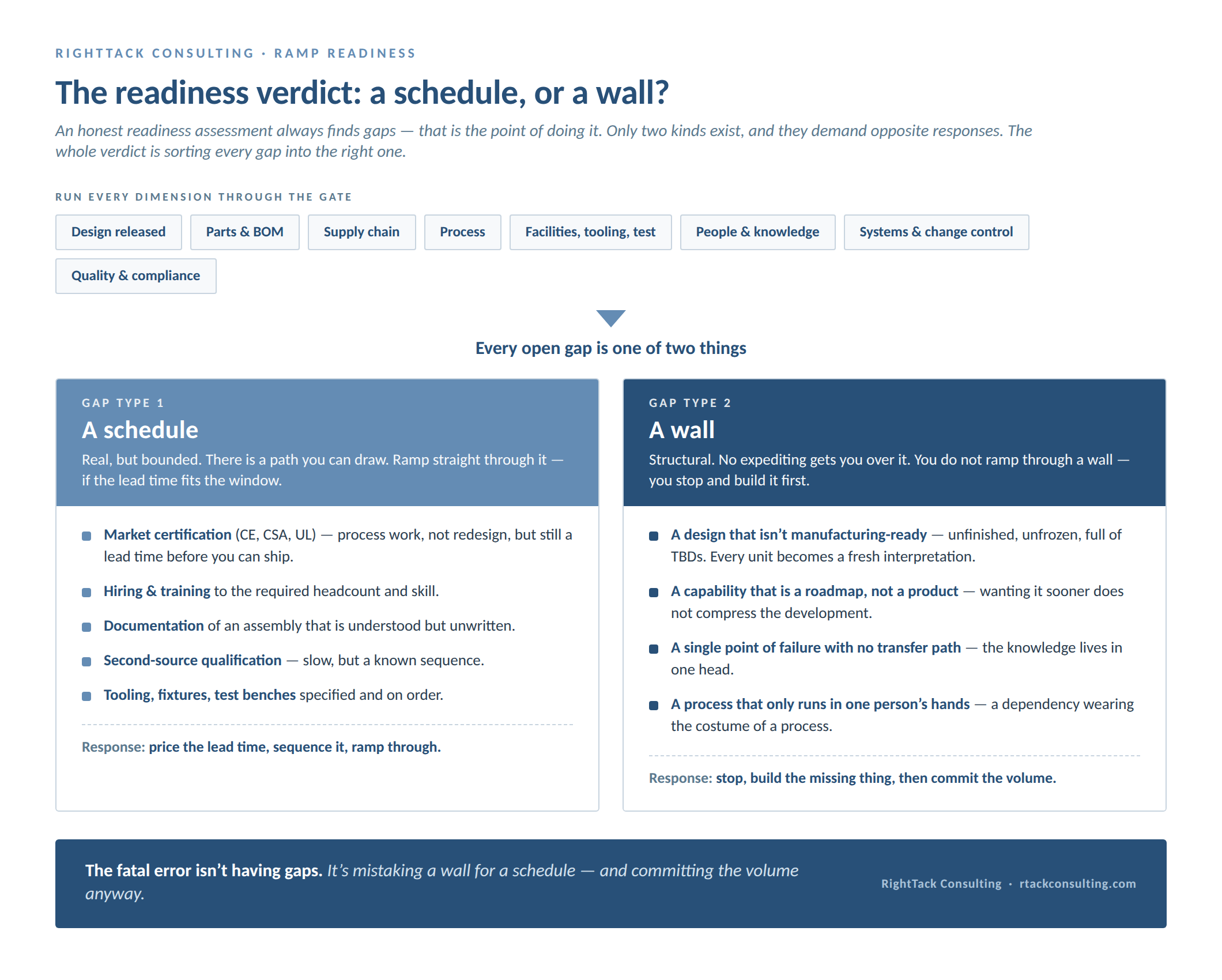
The verdict comes down to one distinction: a schedule, or a wall
An honest readiness assessment always turns up gaps — that is the point of doing it. What separates a useful assessment from a demoralizing one is that it sorts every gap into exactly two kinds, because only two kinds exist and they demand opposite responses. Some gaps are a schedule: real, but bounded, closable with time and money on a path you can draw. A missing market certification is usually process work rather than redesign — a file to compile and an assessment to pass — but it still imposes a lead time before you can ship into that market. Hiring and training is a schedule. Writing the documentation is a schedule. Qualifying a second source is a schedule. You can ramp straight through a schedule gap, provided the schedule fits inside the window the opportunity gives you.
Other gaps are a wall: structural, and no amount of expediting gets you over them. A design that is not manufacturing-ready is a wall — you cannot ramp your way out of an unfinished design, you can only stop and finish it. A capability that is genuinely a roadmap rather than a shipping product is a wall; wanting it sooner does not compress the development. A single point of failure with no transfer path is a wall until you build the path. The entire discipline of a readiness verdict is this sorting: name every gap, price the lead time on the ones that are a schedule, and be ruthlessly honest about the ones that are a wall — because the fatal error is not having gaps, it is mistaking a wall for a schedule and committing the volume anyway.
Every open gap is one of two things — a schedule you can ramp through, or a wall you have to stop and build. Confusing the two is how a good opportunity turns into a bad quarter.
And the gate stays, whatever the schedule says
None of this is an argument for elegance or for waiting. In a fast ramp there are no style prizes: the plan that is ugly and works beats the elegant one that arrives after the quarter has closed, and the first constraint that will bind should be found on paper, in advance, with a relief action already named against it — not discovered on the floor when it stops the line. But ugly is not the same as undisciplined, and the one thing that does not flex under schedule pressure is the readiness gate itself. Sign it off before first article, not after. The moment the gate becomes advisory — the moment “we’ll fix it during the ramp” becomes an acceptable answer — you have stopped doing readiness and gone back to hoping.
A word on where I sit in this
I am not a design-for-manufacture specialist, and I am not a domain-technology expert in any one field. The deep DFM and DFMA work, and the process-physics judgment on a particular technology, are done with people who do exactly that for a living — and on a real assessment I bring them in. What I own is the bar and the integration: knowing what “manufacturing-ready” actually has to contain, running the gate across every dimension, knowing which specialist to pull in and what “done” looks like when they are finished, and turning all of it into one assessment a board can act on. Knowing what you do not know, and who to call, is part of the discipline — not a hole in it.
So when the opportunity lands and the room asks whether you can build more, treat that as the warm-up. The real questions are whether the design is finished, whether the dull audit of parts and suppliers and process actually closes, whether the capability survives one person leaving, and whether each remaining gap is a schedule you have priced or a wall you are pretending is a schedule. Answer those in advance and a surge becomes the best thing that ever happened to the business. Answer them on the floor, in real time, and you will have proven you could win the order but not that you could keep it.
That is the work I do.
The verdict, in one view
Where this goes next
Congratulations, you won the order. Can you build it? →
The ramp-readiness method — the readiness gate signed off before first article, phased volumes with the first constraint found on paper, and a value plan the board can hold you to.

