
The company changed. The way it runs didn’t.
Independent operating partner to funds and CEOs of equipment and industrial manufacturers in periods of rapid change — a ramp, a downturn, or a new owner.
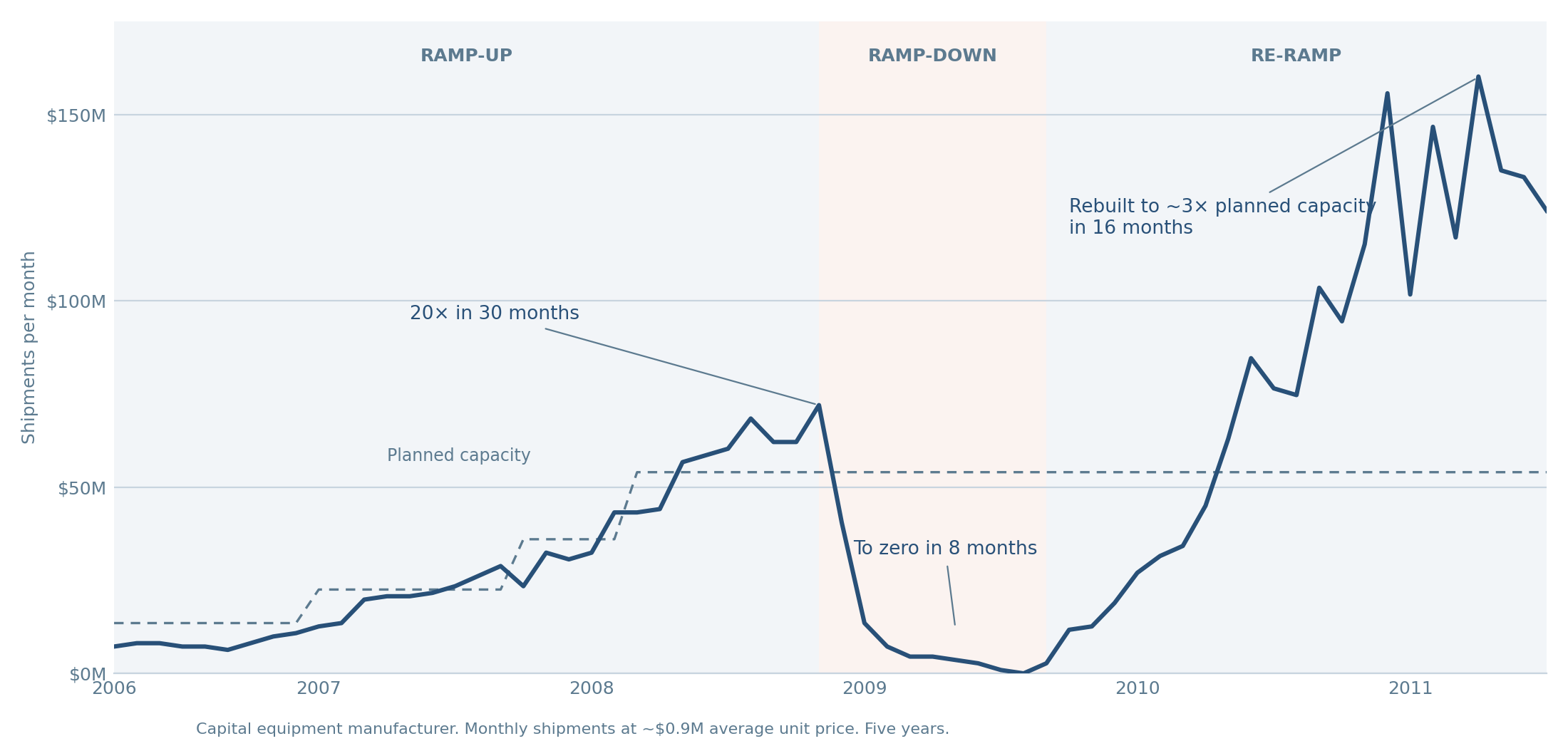
Ten sectors, five ownership models, one plant that did all three phases in five years.
If you run the company
You won the big order and now have to build it. Your contract manufacturer is running you. Nobody can say which revision is current. You hear about problems three weeks late.
Each of those is control sitting somewhere other than with you. I help put it back — in a structure your managers keep and run without me.
If you own it
Operational diligence before the deal. A hundred-day plan that gets executed, not admired. Where the money is actually made and what the footprint should be sized to. Governance installed in month one, not renegotiated in month fourteen.
Can they actually build it at scale?
An independent read on whether a company can do what it says it can — rated on the published TRL and MRL scales, the gap costed in money and months. Written for the person with money at risk, not the company being assessed.
The methods
Decide what to sell, then define exactly what you ship. Decide where you build it, who builds it, and whether you can ship it when the order lands. Then run it with visibility, install the organizational structure and the systems behind it, survive the turn — and show what it was worth. Most simplification programs get the cost out once and watch it come back; here is why.
What the work is for
Avoid a plan that reads beautifully and never gets done
Value creation & governance
The decisions, in the order they get made
What to sell, and why they will buy it
Product strategy & roadmap
Knowing exactly what you ship
Product definition & change control
Where you build it — and how you can defend the decision
Manufacturing strategy & footprint
Who builds it, and whether the price is right
Sourcing & contract manufacturing
Congratulations, you won the big order. Can you build it?
Scale-up & cost-down · ramp readiness
The volume arrived. So did the competition.
Scale-up · cost-down planning
It’s hard to make forecasts, especially about the future
Planning, visibility & risk
The market just turned. What now?
Downside planning & exposure
What all of it rests on
Who decides when you are not in the room?
Organization & people
Buy the system last
ERP, PDM & PLM
You get me.
No analysts, no partner who appears for kickoff and readout. I’ve run the plants, carried the number, and made the plan work after the consultants left. What I build is a skeleton, not scaffolding: it sits inside the business, carries load, and is yours. The engagement is designed to end.
Where this has been done
Solar and semiconductor capital equipment. Battery energy storage and grid-scale power electronics. Materials testing and laboratory instruments. Extrusion and plastics machinery. Paper mills and saw mills. Oilfield services. Industrial aftermarket for food processing and flexible packaging. Two-step distribution. Building products. Air conditioning duct manufacturing.
Venture backed, private equity owned, family owned, listed, and through an IPO. Most of the methods on this page were used at the plant in the chart above and refined over the years.
A first conversation costs nothing and usually settles within half an hour whether I’m the right person. Sometimes the answer is no. That’s a useful half hour too.

