
Technology & manufacturing readiness assessment
Can they actually build it, and at scale?
An independent read on whether a company can do the thing it says it can do — written for the person with money at risk, not for the company being assessed.
A pitch deck will tell you the technology works and the factory is ready. Both statements are usually true in the sense the person saying them means, and misleading in the sense you need.
I go and find out. Management and the technologists first, then the site, then independent work on the technology landscape and the supply base. What comes back is a written assessment of where the technology and the manufacturing capability intersect, what it will cost in money and months to close the gap, and what would have to be true for the optimistic case to hold.
Commissioned by venture funds before a round or a milestone payment, private equity alongside commercial and financial diligence, corporate acquirers assessing a supplier or a target, and family offices without an in-house operating partner.
How it runs
- Framing call with whoever is paying. What decision does this inform, and what would change your mind? An assessment that cannot change a decision is not worth commissioning.
- Management and technologists, separately where possible. The gap between what the executives believe and what the engineers believe is often the finding.
- On site. The line, the test rigs, the first article, the people. The walk around the back of the plant. Most of what matters is not in the data room.
- Independent research. Technology landscape, competing approaches, patent position, supply base and its chokepoints.
- Report, then read-out. Written first, presented second, so the argument survives without me in the room.
- Follow-up at an agreed interval, rated for movement.
What the report contains
- Bottom line up front — can they do it, by when, and what has to be true
- TRL and MRL ratings, with the evidence behind each
- The gap, costed in money and months
- Key person and single point of failure risk, named
- Ranked issues, each with an owner and a date
- What would change the answer
Rated on the published scales
Technology Readiness Levels 1 to 9 and Manufacturing Readiness Levels 1 to 10, not a bespoke rating. A number on a published scale forces the evidence to be stated in a way an adjective never does, and it stays comparable across a portfolio.
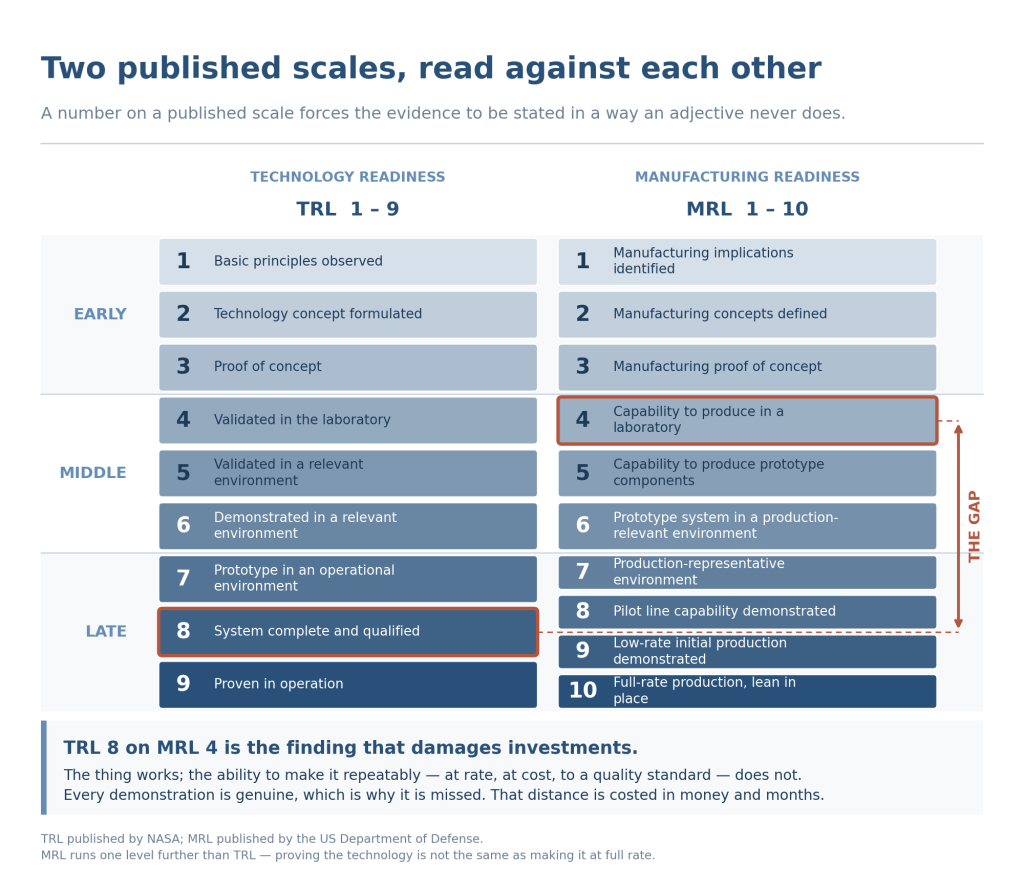
The gap that damages investments is rarely a technology gap. It is high technology readiness sitting on top of low manufacturing readiness — the thing works, and the ability to make it repeatably, at rate, at cost and to a quality standard does not yet exist. It is easy to miss because every demonstration is genuine, and it is the most common reason a plan slips by a year or more.
Built to be repeated
Most assessments are a snapshot. This one is built to be run again — same scale, same issue list, rated green, amber or red for movement since the last visit. That turns a report into a tracked position, which is what you want once you are holding the asset rather than deciding whether to buy it.

