
Sourcing, outsourcing & contract manufacturing
Who builds it, and whether the price is right
“Our contract manufacturer is running us, and we cannot tell if the price is right.”
▸ Read the thinking first: working with a contract manufacturer · sourcing strategy · interface-defined procurement
Outsource the operation. Never outsource away the knowledge of how the operation works.
What it looks like from the inside
- Sole-sourced categories nobody has quantified
- Quotes accepted because there is no independent view of what the thing should cost
- A contract manufacturer whose scope was set by their capability rather than your strategy
- Inventory risk arguments that only surface in the first crisis
- Supplier changes arriving as a surprise, after the fact
The method
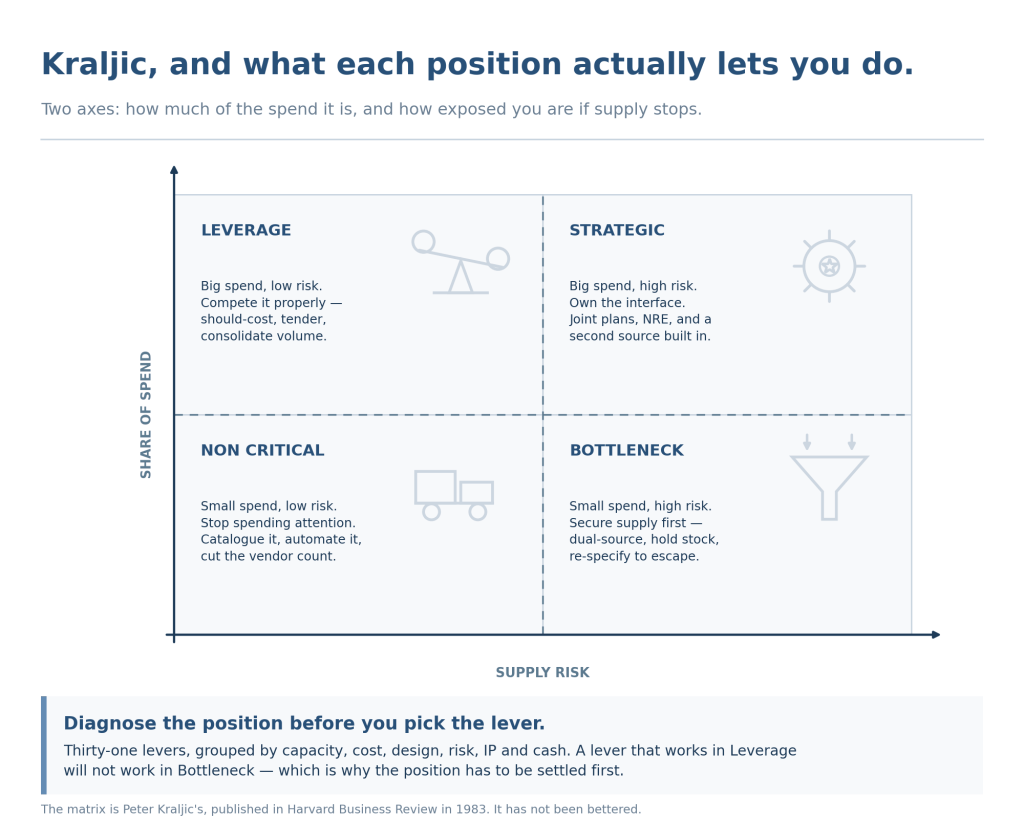
Category strategy starts with position — where each category actually sits on supply risk and spend, the two axes Peter Kraljic identified — and then builds forward from business goals through to governance. Thirty-one levers, grouped by what you are trying to achieve rather than by procurement technique: capacity, cost, design, risk, IP, cash.
Should-cost is modeled by supplier archetype and target country, with a shop-rate build-up as the cross-check, and every assumption declared as an assumption rather than buried as a fact. The point is not to know the supplier’s cost. It is to be able to have an informed argument about a quote.
Contract manufacturer work runs the full lifecycle — selection, contract, ramp, oversight, exit. Including exit, at the start, because a relationship you cannot leave is not a relationship you are negotiating.
And supplier change control runs inbound as well as outbound. Most companies control their own engineering changes and have no mechanism at all for the ones their suppliers make.
Be worth at least five per cent of your contract manufacturer’s plant revenue, and no more than twenty per cent of their company revenue.
Below the floor you are not worth their best people. Above the ceiling you have quietly become their business, and their problems become yours whether you like it or not.
You end up with
A sourcing strategy, a cost model that lets you argue with a quote, and a contract manufacturer relationship you are running rather than reacting to.
- Category plan with an owner and a date against every move — phased nought to three, three to nine and nine to eighteen months, with decision gates between
- Should-cost model by archetype and country
- Term sheet covering process specification, tooling ownership, test criteria, data access, second source and resident engineer
- Supplier dashboard with a quarterly change review that catches supplier changes before they arrive in a shipment
▸ Working the relationship: the supplier site visit · the commercial pre-read · briefing counsel
When this is the wrong tool
If the part is genuinely commodity and interchangeable, buy it on price and spend the effort elsewhere. And if you have one supplier because there is only one supplier, no amount of category strategy creates a second one — that is a market structure problem and needs a different conversation.

