
Whitepaper · Value creation & governance
Everyone signed the plan. Nobody owns Monday.
The operations half of a value creation plan — objectives traced down to the changes that move them, decision rights settled before the decisions arrive, and an operating cadence that survives a bad quarter. Written for the person who has to make the plan happen, not the person who built the model.
A hundred days after close, the value creation plan exists. It was built properly. The model runs, the bridge from entry multiple to exit multiple is drawn, the sponsor and the CFO have argued it line by line, and the investment committee approved it. It is a good plan. And when you walk the plant and ask a shift supervisor what he is doing differently from the week before the deal, he can tell you about a new reporting line and a request for weekly numbers. Nothing else has changed.
This is not a failure of will and it is rarely a failure of the plan’s arithmetic. It is a failure of translation. Somewhere between an EBITDA bridge and a Monday morning there is a layer that most plans skip, because the people who build the plan are not the people who would have to build that layer, and nobody notices the omission until the first quarter’s numbers arrive looking exactly like last year’s.
What is actually missing
The sponsor can build the model. The CFO can build the model. Between them they will produce a defensible view of what the business is worth, what it could be worth, and roughly which levers close the gap — pricing, mix, procurement, footprint, working capital. That work is genuinely hard and it is genuinely done.
What is usually missing is the operations half: what actually has to change in the plant, in the supply base, in the product definition and in the organization, in what order, by when, owned by whom, and what each change is worth in the units the investment committee already uses. Not a second financial model. The same plan, run through the operations lens, so that every number in the bridge has a physical act attached to it and a name against that act.
Objectives are not a plan. A plan names what changes, who owns it, by when, and what it is worth.
The test is simple and it is brutal. Take any line of the value bridge — say four points of gross margin from procurement — and walk it downwards. Which categories. Which suppliers. Which of those are under contract and until when. Who is negotiating them. What has to be true about volumes and forecasts for the supplier to say yes. What happens to the number if the second source does not qualify in time. If the walk stops after two steps, the line is an objective wearing a plan’s clothes, and it will still be an objective at the next board meeting.
Objectives, drivers, and the traceability rule
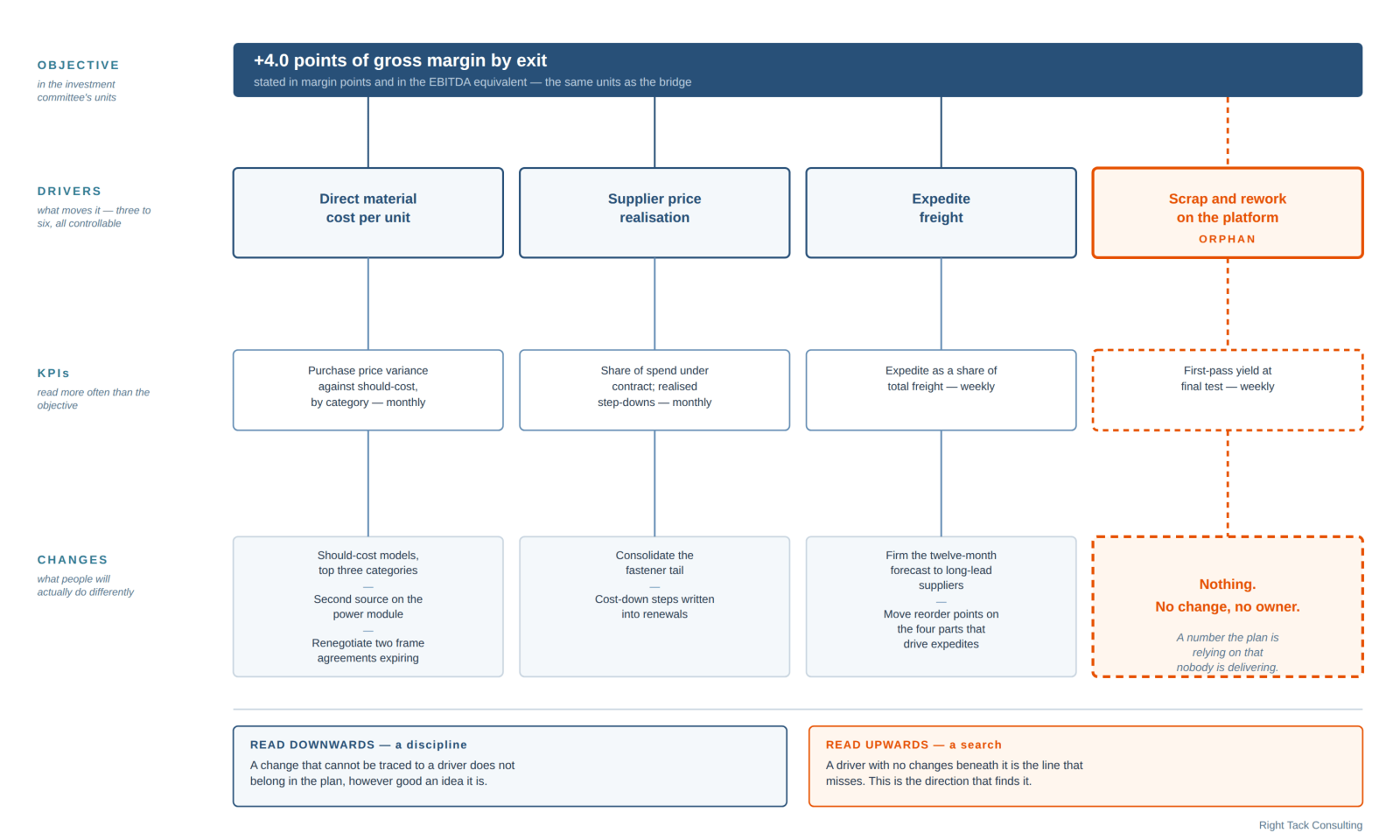
The structure that survives is unglamorous. Financial objectives at the top, in the units the investment committee wrote them in. Underneath, the operating drivers that move each objective. Underneath those, a KPI tree — the measures that tell you a driver is actually moving, at a frequency short enough to act on. And underneath that, the operational changes themselves: the specific things people will do differently.
Then apply the rule that does most of the work: a change that cannot be traced to a driver does not belong in the plan, however good an idea it is. Every operations team has a list of things it has wanted to do for years, and the arrival of new ownership is the moment that list tries to get itself adopted. Some of those items are excellent. If they do not move a driver, they are not part of this plan, and saying so early is kinder than letting them consume the first two quarters and then be quietly dropped.
The rule runs in the other direction too, and that is the direction that finds the real gaps. Take each driver and ask which changes move it. If a driver has no changes underneath it, you have found a number the plan is relying on and nobody is delivering. That is almost always the line that misses.
Decision rights before decisions
Plans stall in month four, and they nearly always stall the same way: a decision that needs making sits waiting for someone to be sure they are allowed to make it. Capital release, supplier switching, headcount, pricing exceptions, the authority to stop a shipment. Under previous ownership these were settled by custom and by knowing who to ask. New ownership deletes the custom and does not immediately replace it.
So the delegation of authority matrix is not administrative tidiness to be done when there is time. It belongs in the first hundred days, before the decisions it governs start arriving, and it should be specific enough to be boring: thresholds in currency, named roles, what needs a board paper and what does not, and what an operating manager can do on a Tuesday without asking anyone. The cost of not having it is invisible in the plan and enormous in the calendar.
The hundred days is decisions and installations
The hundred-day plans that circulate are task lists: sixty or ninety items by workstream, each with an owner and a date, and most of them meetings. A task list is not wrong. It is just not the thing that decides what the business can do in month four. Two categories are, and separating them is worth the half hour it takes.
Decisions are what gets settled once and then constrains everything after it. Who decides what. What the units are. What the operating cadence is. Which system is the system of record. These are cheap to make early and expensive to make late, because by the time you get to them the decisions they govern have already been made ad hoc, differently, by whoever was in the room.
Installations are what did not exist before and now runs without anyone remembering to run it. The weekly dashboard. The monthly operating review. The tracker that turns the bridge into lines with owners and dates. An installation is finished when it survives the person who installed it going on holiday — not when it is first used.
Sorted that way the hundred days takes a shape. Units and decision rights in the first fortnight. The driver tree agreed by week six with the people who own the drivers, rather than written at them. The review cadence held once badly rather than deferred until it can be held well. And a rehearsal reforecast at the end, run in the plan’s units before it matters, so that the first real one is not also the first attempt.
The test is a subtraction. Cross out every line on the plan that is a meeting or a document review. What is left should still change what the business can do. If it does not, the plan was a calendar.
Find the profit engine before you plan around it
Most industrial businesses at this point in their life do not know precisely where they make money. They know it at the plant level and at the annual level, which is not the same thing. Eighty-twenty on the portfolio and a cost-to-serve view — the discipline as ITW built it — separates the core profit engine from the long tail that is being cross-subsidized by it.
This matters to a value creation plan in a way that is easy to underestimate. Growth applied indiscriminately across a portfolio with a cross-subsidized tail does not produce the margin the bridge assumed; it produces more revenue at the blended margin, which is a different and much less valuable outcome. And simplification without that view cuts the wrong things — some of the tail is genuinely unprofitable and uncoupled, some is unprofitable but attached to a customer worth keeping and should be separated and re-costed rather than removed, and some is load-bearing and needs better structure underneath it rather than deletion. Three different moves, and a plan that only owns one of them will not deliver the number.
The cadence is the plan’s immune system
Every plan is fine in month one. What decides whether it is still alive in month nine is the operating rhythm around it: a board pack that reports against the plan’s own structure rather than against a generic template, a monthly operating review where the drivers are the agenda, and a quarterly reforecast in the same units the plan was written in.
The word that matters here is same. Plans die quietly when the reporting drifts into different units from the plan — the bridge is in margin points, the board pack is in absolute EBITDA, the operating review is in tonnes and line rates, and after three quarters nobody can say whether the plan is on track without a reconciliation exercise that nobody has time to do. Hold the units and a bad quarter is legible: you can see which driver moved against you and decide what to do. Lose the units and a bad quarter is just an argument.
What the operations half consists of
- The bridge, walked down. Every value line traced to named operational changes, with the owner, the date and the value in the investment committee’s units.
- A driver tree with no orphans. No change without a driver above it; no driver without changes beneath it.
- A hundred-day plan that is a sequence of decisions and installations, not a list of meetings.
- A delegation of authority matrix settled before the decisions it governs arrive.
- An eighty-twenty and cost-to-serve read on the portfolio, so growth is applied where it converts and simplification cuts the right third.
- A board pack and operating cadence reporting against the plan’s own structure, in the plan’s own units, quarter after quarter.
Where this is the wrong tool
Capital structure, the financing case and the model itself are the sponsor’s work and the CFO’s, and an operations person wandering into them adds noise rather than value. This is the half that sits underneath those, not a competitor to them.
And there is a sequencing trap worth naming. A value creation plan built before anyone has done an operating diagnosis is a forecast with a KPI tree attached — it will look rigorous, it will pass the investment committee, and it will be wrong in ways nobody can see until the second quarter. If the diagnosis has not been done, do that first. It is cheaper than a plan built on assumptions, and considerably cheaper than the credibility cost of missing a number you told the board you would hit.
Why this is the top of the structure, not the end of it
It is tempting to treat a value creation plan as the thing that happens after the operational work — the write-up, the scoreboard. It is the opposite. It is what the operational work is for, and stating it first is what stops the rest of the program becoming a collection of improvements that are individually sensible and collectively unaccountable.
The plan is also the only artifact in the engagement that everyone reads. The sponsor reads it, the board reads it, the management team reads it, and the operating managers who have to deliver it read it. If it is written in one set of units and one vocabulary, those four audiences are having the same conversation. If it is not, they are having four, and the difference will not show up until the quarter that misses.
That is the work I do.
Where this goes next
Avoid a plan that reads beautifully and never gets done →
The value creation and governance method — the operations contribution to the plan, the hundred days, the decision rights and the cadence.

