
Value creation & governance
Avoid a plan that reads beautifully and never gets done
“We have a value creation plan. Nobody can tell me what operations does differently on Monday.”
The sponsor and the CFO can build the model. The operations half is what is usually missing.
What it looks like from the inside
- A value creation plan the operating team cannot act on
- Objectives with no KPI tree beneath them, so nobody can say which change moves which number
- Profitable segments quietly subsidizing unprofitable ones
- New leadership with a hundred days and no defined decision rights
- A board pack that reports activity rather than value
- Quarterly reporting in units the plan was never written in
The method
This is not a second financial model. The sponsor has one and the CFO can build another. What is missing is the operations half — what actually has to change in the plant, the supply base, the product definition and the organization, in what order, by when, owned by whom, and what each change is worth in the units the investment committee already uses.
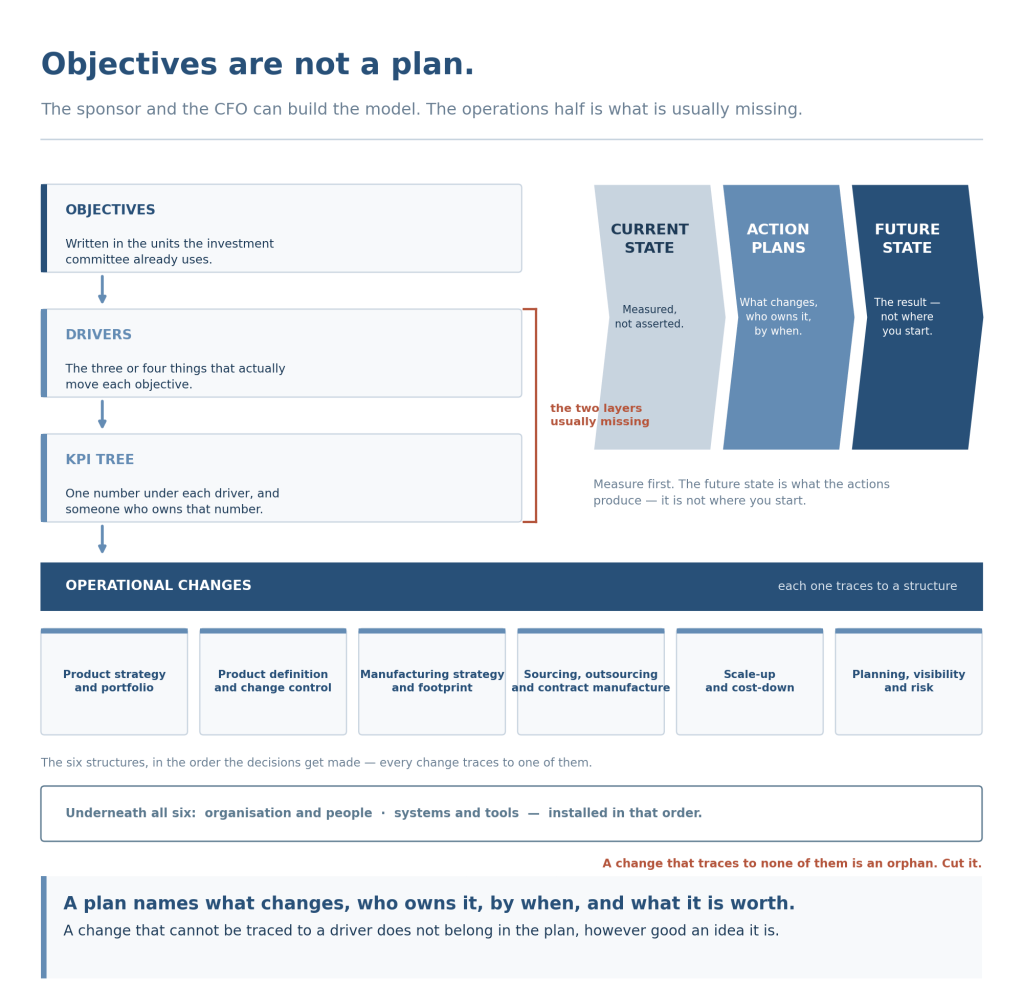
It runs the operating plan through the financing lens rather than the other way round. Objectives come first, then the drivers beneath them, then a KPI tree, and only then the operational changes that move each driver. A change that cannot be traced to a driver does not belong in the plan, however good an idea it is.
Decision rights come before decisions. A hundred-day plan and a delegation-of-authority matrix — recommend, decide, approve, by threshold — so the plan survives the first disagreement about who was allowed to commit what.
Then eighty-twenty and cost-to-serve across the portfolio, to find the core profit engine and see plainly where value is created and where it is cross-subsidized. Those methods come from ITW, and they travel well.
Tracking is quarterly, against the same units the plan was written in. A plan reported in different units from the ones it was built in is a plan nobody can hold anyone to.
The one-page version of all this is the Hoshin X-matrix: three-to-five-year breakthrough objectives along the bottom, this year’s objectives on the left, the improvement priorities that deliver them across the top, a numeric target and one named owner for each on the right, and dots where they connect. I have used it since a lean deployment in 2009 and on two operating plans since. Its value is less the page than the argument it forces — a priority with no dot to an objective, no target, or no owner cannot stay on it. Ten priorities is the ceiling; the matrix is redrawn once a year and left alone in between.
Objectives are not a plan. A plan names what changes, who owns it, by when, and what it is worth.
Most value creation plans are strong on the first and silent on the rest. That is why the operating team reads one and cannot tell you what they are meant to do differently on Monday.
You end up with
The operations contribution to the value creation plan, written in the units the investment committee already uses — and a governance structure that holds it after the first bad quarter.
- KPI tree running from objectives through drivers to the named operational changes that move them
- Hundred-day plan with owners and dates against every move
- Delegation-of-authority matrix — recommend, decide, approve, by threshold, with exception handling
- Cost-to-serve view showing where value is created and where it is cross-subsidized
- Board pack and operating cadence that survives contact with a bad quarter
- Quarterly tracking in the units the plan was written in
When this is the wrong tool
If the question is the capital structure or the model itself, that is the sponsor’s work and the CFO’s, and I am not the right person. But if there is no operating diagnosis yet — if nobody has established what the plant, the supply base and the product definition can actually do — then a value creation plan built on top of that is a forecast with a KPI tree attached. Do the diagnosis first.
▸ Read the thinking first: everyone signed the plan, nobody owns Monday.

