
Downside planning & exposure
The market just turned. What now?
“Orders have stopped and nobody can tell me what we are committed to.”
▸ Read the thinking first: plan for the downside
The number you want on a Monday morning is the one you should have worked out last quarter.
What it looks like from the inside
- Nobody can separate what is committed from what is cancellable
- Deposits and progress payments treated as spent rather than as recoverable cash
- A supply base being cut in the order the invoices happen to arrive
- A downside case that was written to be shown to a lender, not to be used
- A recovery that arrives faster than anyone planned for, into a supply base that has been burned
- We have a risk register. It was last updated for the audit.
The method
Separate the book into committed and cancellable, then value each properly — cancellation cost, restocking, tooling written off, deposits recoverable.
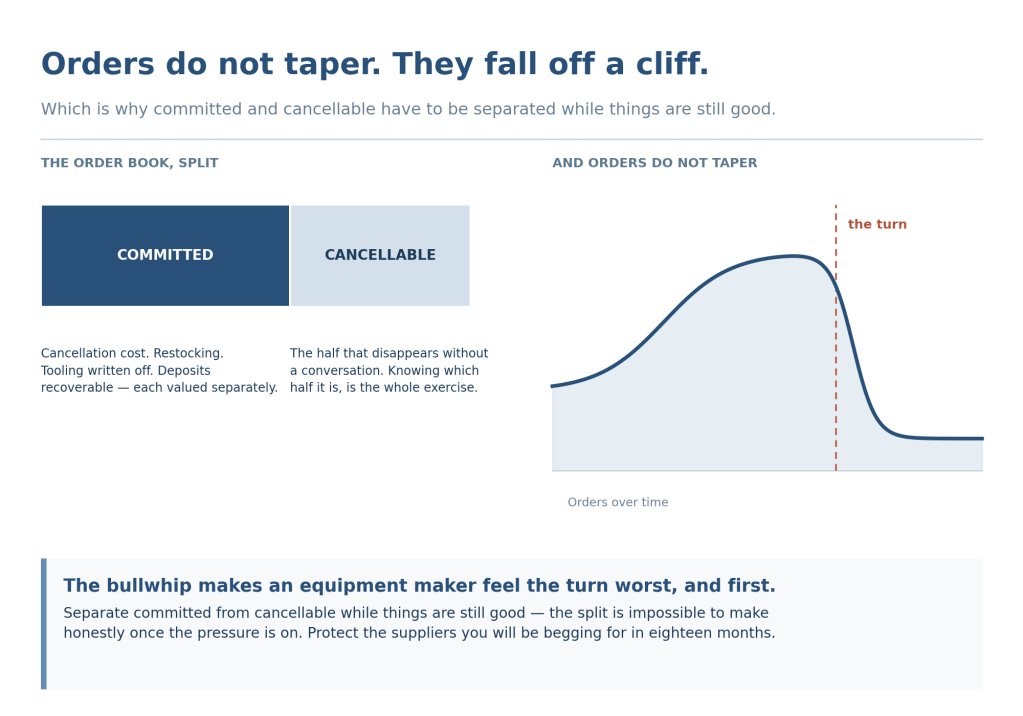
Build the scenario table down to the worst case you are willing to say out loud, before the event. A downside plan written during a downturn is a negotiation with yourself.
Decide in advance which suppliers you protect. Not all of them, and not the cheapest — the ones whose capacity you will be fighting for in eighteen months. The suppliers you burn on the way down are the ones who deprioritize you on the way up.
And treat recovery as the harder half. Equipment demand does not decline politely; it falls off a cliff and then comes back faster than the plan allows for.
Keep a list. One register, one row per commitment, a named person on every row, refreshed weekly against a data deadline rather than in a meeting. Each row carries its exposure from three sources — cancellation charges, material received, cash advanced — net of the deposit held, and is ranked in dollars by what it costs and how soon you feel it, not by a color on a grid. That is the mechanics behind the number. Without it the scenario table is fiction inside a quarter.
Why me for this one
I have managed through several of these, Lehman included. Orders down by an order of magnitude in a quarter, supply chain obligations cut by roughly two thirds inside four months, and the business cash positive at the end of it — by treating vendor advances as cash to be repatriated rather than money already gone.
I learned supply chain from Charlie Fine at MIT, and his Clockspeed is where the argument is set out properly. Clockspeed and the bullwhip are not references to me. They are the two forces that decide whether an equipment business survives its own order book.
You end up with
A number for what a downturn actually costs you, worked out before you need it, and a sequence for unwinding it that does not wreck the supply base you will need on the way back up.
- Committed spend separated from cancellable
- Deposits and progress payments treated as recoverable cash
- Scenario table running to the worst case
- A decision, made in advance, about which suppliers you protect
- A live register — every commitment on a row, a named owner, weekly refresh, quarterly re-run to the worst case
When this is the wrong tool
If the market did not turn — if the business changed shape over several years and the overhead never followed — the problem is structure, not exposure, and this register will only tell you what you already know. That case is the fort: the business shrank; the overhead did not.

