
Whitepaper · Product strategy & roadmap
The business shrank. The overhead did not.
A turnaround is not a growth plan run backward. It is a retreat to the customers and products that already pay, with the fixed cost cut to what that core earns at the bottom of its cycle — and then one move outward at a time.
The shape is always the same. One part of the business carries the company — usually the installed base, the parts and the upgrades, the customers who have bought from you for twenty years. Everything else loses money and everyone knows it. The plan on the table still says grow out of it: win the big systems order, enter the adjacent segment, quote everything, everywhere. And the fixed cost — the building, the engineering headcount, the sales offices — is still sized for the company you were, not the one the order book says you are.
Said out loud, in the words I have heard it said: without the aftermarket we would be dead. That sentence is not the problem. It is the strategy, and nobody has been allowed to say so.
Charge that hill and you lose
The instinct in a shrinking equipment business is to fight on every front, because every front once belonged to you. So the company competes head-on against entrenched rivals in segments where it is third or fourth, funds the fight from the one segment where it is first, and calls the result a portfolio. What it actually has is a profitable core subsidizing four unprofitable habits.
The cost of that is not only the losses. Trying to be a full-line supplier with a half-line budget means nothing gets standardized, nothing reaches world class, cost never comes down because the volume is spread across too many designs, and R&D is thin everywhere. The company delights no one and disappoints many. The customers notice before the board does.
Profitable segments cannot subsidize unprofitable ones and stay profitable. That is arithmetic, not strategy.
Find the fort
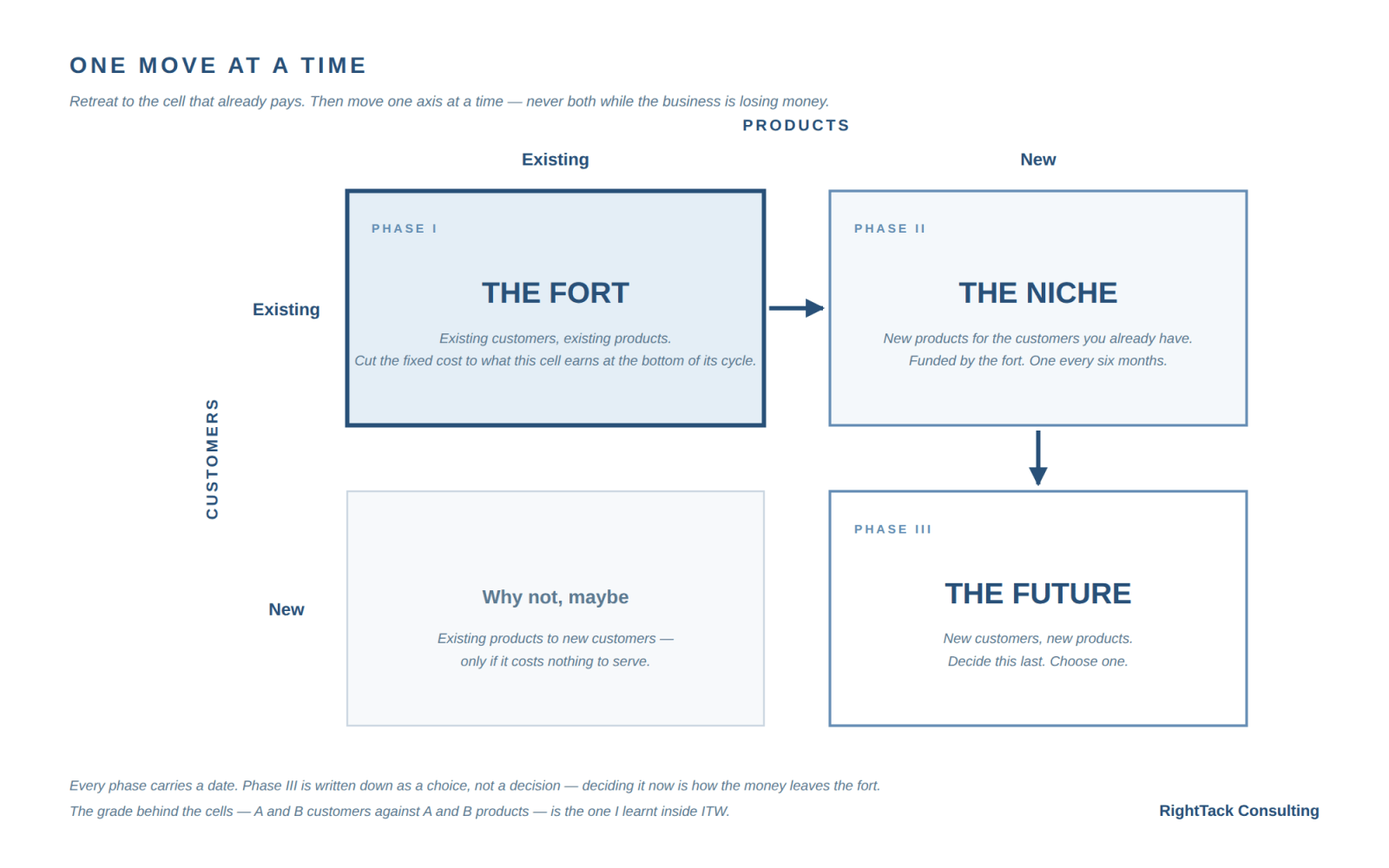
Grade the customers A and B. Grade the products A and B. The fort is the cell where A meets A — and in an equipment business it is very often the installed base: the customers who own a lot of your machines, buy the parts and upgrades, will survive the consolidation in their own market, and are still worth calling on next year. The A products are the ones that serve those machines, build on what you are actually good at — the die, the controller, the process know-how — and make the customer more competitive in a way they can measure. Ten of each is usually enough. Write the qualifying criteria down, because the argument about who is an A customer is the argument the whole plan turns on. The grade is one I learned inside ITW; the product strategy paper covers the other three cells.
Then the part the deck usually leaves out. The fort has to be sized. Take the revenue of that one cell at the bottom of its cycle — not the average year, the worst one you are prepared to say out loud — and set the fixed cost to generate cash at that level. Not break even. Cash, with development still funded. If that means half the floor space, consolidate into half the floor space. If it means outsourcing everything in the B column and bringing the A products back in-house so they are quick-turn and always available, do that. The smaller cost structure is not the price of the retreat. It is what makes the smaller business profitable, and it is the slide the audience will not believe until they see the number.
Size the fixed cost to the bottom of the core’s cycle. Then it makes money in every year, including the year you are in.
A fort with no new products is a wind-down
Here is where a turnaround separates from a liquidation. A business selling existing products to existing customers, and nothing else, atrophies. The installed base ages out, a competitor retrofits it, and the parts revenue that looked like an annuity turns out to have a half-life. So the fort must fund a cadence: a new product every six months that fills a gap in the installed base — a controller retrofit, a rebuild-and-exchange program, an upgrade that takes an old machine to a new specification. Small, quick, sold to people who already trust you. One chief executive I worked for asked whether he could be obnoxious and make it every four. He was right to ask. The cadence is the difference between a company that shrank to survive and one that shrank to stop.
One move at a time
The sequence is the discipline, and it runs on the same grid. Phase one is the fort: existing customers, existing products, cost cut to the trough, cash generated. Phase two is the niche: new products for the customers you already have, paid for by phase one. Phase three is the future — new customers and new products — and the honest plan writes it down as a choice, not a decision. Component specialist, or re-enter systems on a partner’s platform? Choose one, later, when the fort has produced the cash to fund the choice. Every phase carries a date. What you do not do is move both axes at once while the business is losing money, which is what the growth plan was proposing.
The list of what you will not do is the strategy, and it is the half nobody volunteers to write. Segments you exit, named. Science projects that need disproportionate engineering and carry execution risk, stopped. Quoting every opportunity in the world, stopped — because every quote you do not chase is engineering time returned to the fort. A plan without a will not page is a wish list with a smaller budget.
Two small teams
The organization follows the grid. One small, dedicated team owns the fort: the parts warehouse with a fill-rate target, the exchange programs, the retrofits, the six-month cadence, and the customer relationships — because the people those customers want to hear from are the technical ones, and the technical ones have to get out of the building. A second, smaller team runs whatever remains of the systems business as a project manager rather than a manufacturer: buying the major content from partners, buying the core components from the first team, and taking the order to completion without a factory of its own. A small dedicated team beats economies of scale; that is ITW’s operating philosophy, and it holds in businesses a fraction of that size. It is also the answer to the question a board asks in every turnaround — why will this time be different? Because there are no distractions left to hide in.
Saying it — five traps I have watched people walk into
- Do not advertise where it is made now. Customers who bought a name react badly to being told the kit comes from somewhere else. The sourcing shift is an operating fact, not a marketing message.
- Never say rebuild. Employees and customers who lived through the last restructuring hear another one coming. Say what it is: cutting away what was dead so the rest can carry on.
- Expect “you can’t sell that few products to that few customers.” The answer is the cost slide. Have it ready, with the number on it.
- Focus is not in their DNA. People who kept the lights on by chasing every quote will keep chasing them. Acclimatizing them to a smaller, richer book is a workstream with an owner, not a memo.
- Keep the partner deals private until they are signed. A repositioned joint venture or an agent relationship announced early is a negotiation you have already lost.
Where this is the wrong tool
If there is no cell that pays — no customers and products that make money even at the trough — there is no fort to build, and this is a creditor conversation, not a strategy one. And if the whole market fell off a cliff last quarter rather than the business changing shape over several years, the problem is exposure, not structure: that is a different paper. The fort is for the business that has already become smaller and has not yet admitted it.
That is the work I do.
Where this goes next
What to sell, and why they will buy it →
The product strategy and roadmap method — the A and B grade, the where-you-play and where-you-will-not statement, and twelve months of owned actions.

