
Manufacturing strategy & footprint
Where you build it — and how you can defend the decision
“We are about to commit capital and we cannot defend what, where, or how.”
▸ Read the thinking first: where to put the plant · what domestic content actually costs
From product to factory, sequenced — so the answer survives the first change in volume.
What it looks like from the inside
- Org design and headcount set before the process is mapped
- A building chosen before the material flow is drawn
- Equipment bought before takt and capacity are modeled
- A contract manufacturer picked before the make-or-buy boundary exists
- A target cost published that nobody can trace back to a step
The method
Eight stages, in order: product, process, make-or-buy, flow, capacity, ownership, geography, organization. Every stage produces one named output that gates the next — if it does not exist, the next stage is speculation rather than analysis.
Stage 1 is product, and it is a decision rather than a description. Which products should exist, for which customers, at what volume. It runs as a customer and product matrix — A and B customers against A and B products — not a product profitability ranking. That is the ITW method, and I have used it since my years there. A B product attached to an A customer is not the same object as a B product attached to nobody, and treating the two the same is how a simplification program loses revenue it never meant to lose. The matrix is decided in the product strategy method; where it does not exist, stage 1 is where it gets built.
Three outcomes, not one: stop it, separate it and re-cost it with a date to look at it again, or carry it and build the structure that supports it. Everything downstream is sized to whatever survives this stage, which is why it is first — get it wrong and you build a factory for a product set that should have been smaller.
Make-or-buy is decided per process step, not for the product as a whole, and against four lenses in a fixed order: strategic, capability, economic, risk. Deciding economics first is how companies outsource the step that was actually their advantage.
Location is screened before it is scored. Twelve factors, each applied as a pass or fail, and only the survivors get weighted. Scoring a long list produces a defensible-looking average that hides a disqualifying answer.
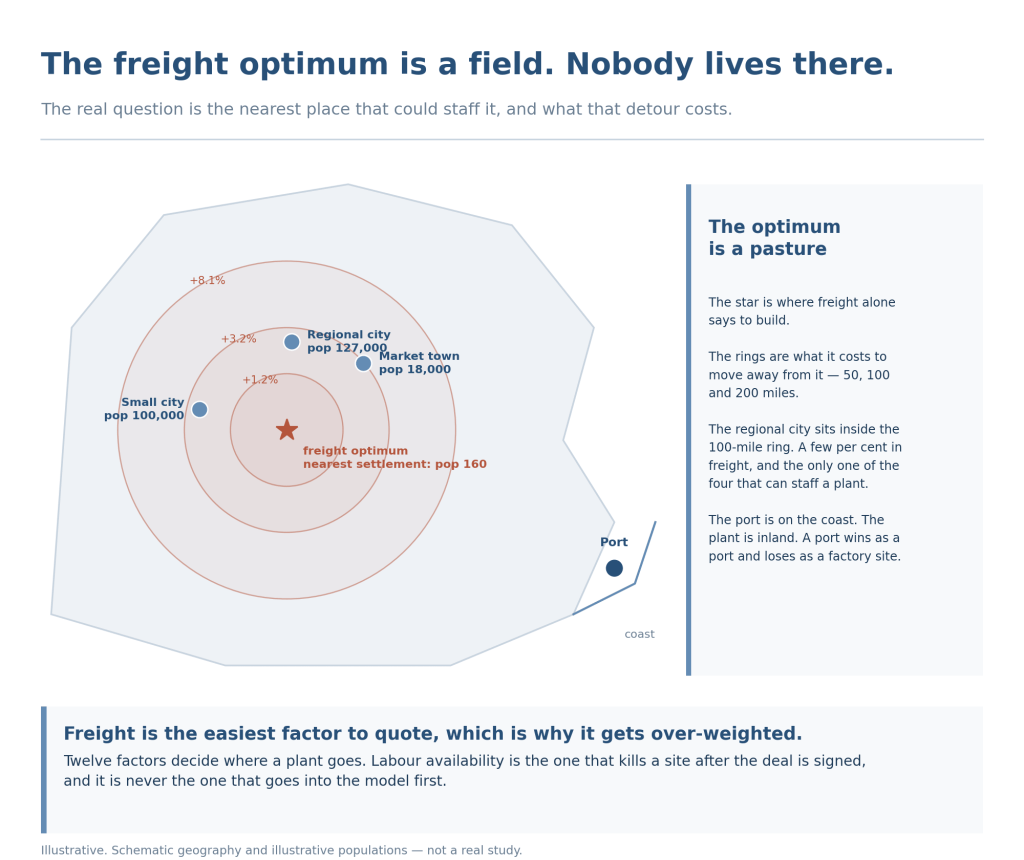
Then landed cost across the shortlist, with the triggers written down that would reopen the decision.
Stages 7 and 8 are where most teams start. They are last for a reason.
Stage 7 is geography. Stage 8 is organization. Where to build it and who to hire are the two questions everyone opens with, and both are downstream of product, process, make-or-buy, flow, capacity and ownership. Answer them first and you will answer them again in eighteen months, at cost.
You end up with
A manufacturing strategy you can take to a board and defend line by line.
- Product and demand picture with a high and low band, not a single number
- Process step register carrying cycle time, yield, capital, labor and IP for each step
- Make-or-buy boundary map with a written reason and a revisit volume against every step
- Material flow with the buffers and the decoupling point named
- Capacity model that answers a new volume without being rebuilt — footprint as an output, not an input
- Weighted site evaluation traced back to your own flow, not a generic scorecard
When this is the wrong tool
If the decision is genuinely reversible inside a quarter, this is too much machinery — take an afternoon over it and move. Depth should match how hard it would be to undo.

