
Product strategy & roadmap
What to sell, and why they will buy it
“We have a roadmap, and I could not tell you why it is that one.”
Decide what to sell in the customer’s money, not in your feature list.
What it looks like from the inside
- A roadmap nobody can trace back to a movement in the market
- Value argued in features and engineering effort, in units the customer’s finance team would not recognize
- Competitors compared from memory, each on a different scorecard
- Price set from cost-plus, or from whatever the last deal closed at
- Disruptions debated rather than compared, because each one is argued differently
- A product plan with no named owner and no date
The method
Three stages, three sessions, at least a week apart. Eight questions in each — twenty-four artifacts and three output pages. Each stage ends in one page, and that page is the next stage’s agenda: nothing starts until the stage above it has an answer. The gap between sessions is where the work happens — the sessions themselves are for deciding.
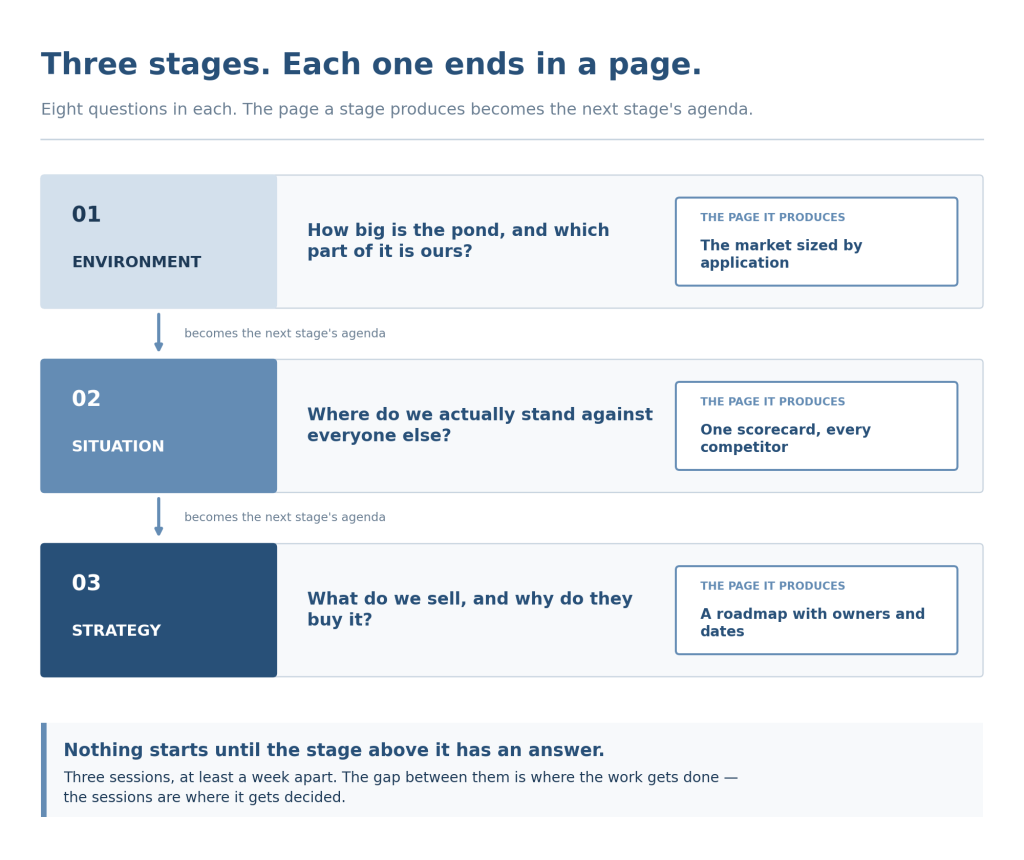
Environment. Size the market and split it by application rather than by geography. Map the value chain end to end and mark where the margin actually sits. Take the cost and performance curve your customers have already committed to — that is the bar every roadmap item has to clear. And test every disruption the same four ways, so they can be compared instead of argued. Ends in one page: the ranked opportunities and threats.
Situation. Score the business against market requirements, and score every competitor on that same single scorecard. One scorecard is the whole point: the moment each competitor gets its own, the comparison becomes opinion. The cells get filled by teardown — architecture and cost — rather than by whichever source happened to cover that competitor, and the cells you cannot fill are marked unknown, which is a finding rather than an embarrassment. Then define the value metric — the unit the customer actually buys in — and test it with real customers before trusting it. Ends in one page: the critical issues to address.
Strategy. Financial and strategic objectives first. Then where you will play, and where you deliberately will not. Then the product roadmap, and separately the technology roadmap — what has to be invented before any of it can ship. Then the risks. In that order, because a roadmap built before the objectives is a wish list with dates on it. The where-you-play statement comes off a grade: A and B customers against A and B products. The business gets built around A products for A customers; B products for B customers are the deletion candidates, and writing them down is the half of the roadmap nobody volunteers for. Ends in one page: twelve months of actions, each with an owner.
The three-stage structure, the value metric and the single-scorecard discipline follow the work of Michael Chase, author of Equipped to Win, on value-based strategy for capital equipment.
One named owner per workstream throughout. The facilitator runs the sessions and owns none of the content — if the strategy leaves with the consultant, it was never yours.
The value is not the deck — it is the skeleton it leaves behind.
A strategy engagement that ends in a document ends. One that ends in a scorecard, a value metric and a named owner per workstream keeps working after the last session, because the structure is still there to argue with next quarter.
You end up with
A product strategy you can defend to a board line by line, and a roadmap every item on which traces back to a movement in the market.
- One page of ranked opportunities and threats, with the evidence behind each
- One page of critical issues — the page the strategy is built to answer
- A value metric in the customer’s own units, tested with real customers before it is trusted
- The same scorecard applied to every competitor, filled from teardown rather than from memory
- Your share of each major customer’s capital spend, and your IP position against theirs
- A target and non-target statement — where you play, and where you deliberately do not
- Product roadmap and technology roadmap, priced in value-metric terms against the competition
- A named risk register for what could break the roadmap
- Twelve months of actions, each with a start, an end and a name
Where this has been done. A sapphire crystal growth furnace business, acquired and scaled. The product strategy this process produced supported roughly a billion dollars of bookings inside two years.
When this is the wrong tool
If you have one product and one customer, you do not have a roadmap problem — you have a concentration problem, and that is a different conversation. And if the roadmap is fine but nothing ships, the constraint is engineering capacity or change control, not strategy. Fixing the strategy will not make the release land.
▸ Read the thinking first: the roadmap is what engineering was going to build anyway — and, for the business that has already become smaller, the business shrank; the overhead did not.

