
Organization & people
Who decides when you are not in the room?
“Every decision still comes back to me.”
▸ Read the thinking first: organize the function by horizon, not by task
▸ The tool comes after: buy the system last
A small dedicated team beats economies of scale. Every time — and it has to keep working when the person who built it is away.
What it looks like from the inside
- The function is a person. Everything routes through them, and nothing is written down
- No one throat to choke — everyone contributes, nobody is accountable for the outcome
- A manager with too many direct reports and no time to develop any of them
- Roles left open for months chasing the perfect candidate, while the work piles onto the people already there
- Nobody can say who decides — only who to ask
- IT designing the business process by default, because nobody else defined it
The method
One outcome, one dedicated team. No shared pools — a pool has a service level, not an owner. Dedication is the rule; headcount is not. Size follows the outcome, and a headcount ceiling is the check rather than the design: if the team will not fit under it, the outcome was drawn too broadly and should be split. The root of this is ITW’s decentralized operating philosophy, and it holds in businesses a fraction of that size.
Five to seven direct reports. The test is simple: if you have more direct reports than there are days in the week to hold a daily one-to-one, you have too many. Seven is the ceiling, not the target, and it comes down where the manager is also carrying the work themselves.
Decision rights before headcount. A named decision, a named approver, a threshold, a review date. If it only works while one person with absolute authority is in the room, it is a personality, not a method — and it will not survive that person taking a holiday, let alone leaving.
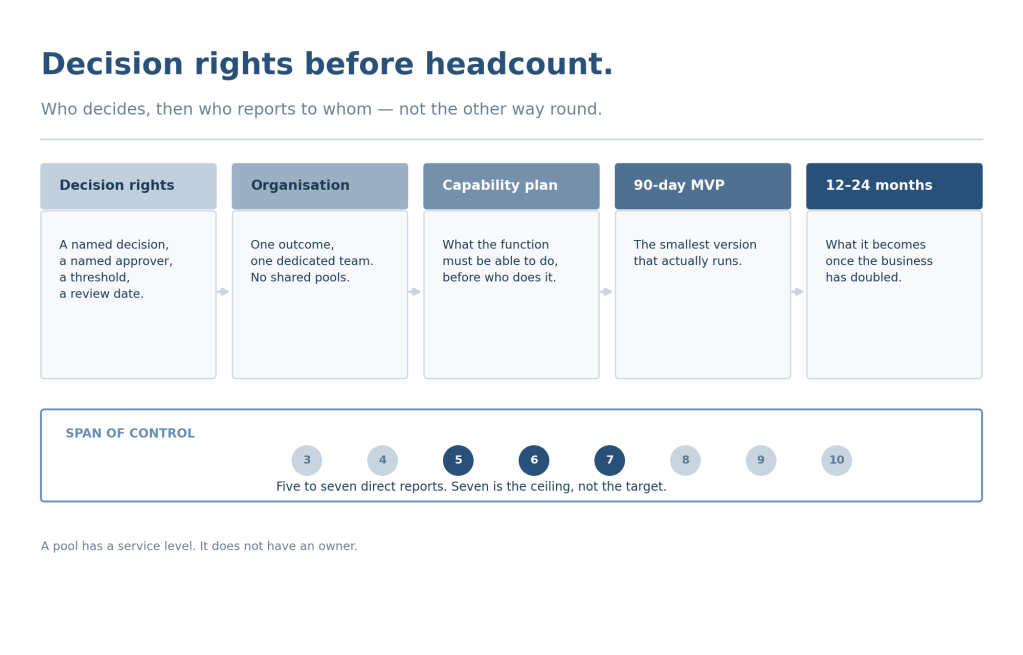
A twelve to twenty-four month organization and capability plan, sequenced, with role charters for the next three hires only. Beyond three, the plan is fiction. A minimum viable system in ninety days with the full one staged behind it, and never paper compliance.
And the function owns the business design of its own tool, though not its configuration. If procurement does not define who can buy and how approvals work, IT will — by default, in the implementation. That is the seam where this method meets the system decision, and it is why the people go in first.
The C players you have working now beat the B or A player you will have tomorrow.
In rapid growth the world changes faster than a perfect search completes, and a role held open for months loads the work onto the people already there while delaying the function existing at all. This is only defensible in the same breath as fire faster. Without the second half it is not a hiring stance, it is a permanently lower bar.
You end up with
A procurement, quality or logistics function that exists as a structure rather than as a person — and keeps running when that person is away.
- Org design with dedicated teams, named outcomes, and spans of five to seven that still hold as volume grows
- Authority matrix — who can commit what, how fast, under what rules, with exception handling
- Capability plan with role charters, hiring criteria, and the exit rule that makes fast hiring safe
- End-to-end process map with the system-of-record boundary named
- Minimum viable data model and a filing standard — if it is not here, it does not exist
- Operating rhythm, a one-page monthly executive narrative, and metric definitions that cannot be gamed
When this is the wrong tool
If the function already exists and works, and the problem is one person’s performance, this is an expensive way to avoid a conversation you already know you need to have. And if the business is small enough that one capable person genuinely is the function, building the structure early is cost without benefit — wait until the second one arrives, then build it before the third.

