
Systems & operational control
Buy the system last.
“We spent two million on the system, and I still can’t tell you what’s in the warehouse.”
What you make, what you hold, what you owe — whether you can answer those fast enough to act is decided before the software is chosen, and mostly off the screen. The system is the last decision in that sequence, not the first.
What it looks like from the inside
- The tier above is always recommended — and always harder to implement than the one you needed
- Every team wants its process kept, and each one kept is a customization you pay for twice
- Go-live lands halfway through, and the floor quietly reverts to the spreadsheet
- The item master crosses over dirty, and the new system is confidently wrong
- The one report the whole thing was bought to produce needs a custom build and another invoice
The method
Check the skeleton before you bolt on the rib. A system bears load only where there is a defined product underneath it — part numbers that mean one thing, a revision rule that holds, a bill of materials that drives the build. That is product definition and change control, and it comes first. A tool laid over a missing skeleton reproduces the gap faster, at more expense, now wearing the authority of a system of record.
Draw the boundaries between product data management, lifecycle management and the ERP before any vendor is met — because vendors are very good at drawing those boundaries for you. PLM/PDM carries what you make: the definition of record, the bill of materials, the revision that actually shipped. The ERP carries what you hold and what you owe: inventory, receiving, the ledger. The overlap a vendor sells you is where the customization bill is born.
Buying late is only safe if you designed early. Before the software question is even sensible, draw the process architecture: what the business actually does, in sequence, with the handoffs between the flows drawn and the supporting functions named — at a level the people doing the work recognize, not a wall poster. That drawing is what makes a phased implementation a plan rather than a series of guesses, and the tell that it is missing is a client who cannot say what Phase 2 contains without opening the vendor’s project plan. It also answers the ISO 9001 process approach head on — the processes needed, and their sequence and interaction — so the same drawing usually carries a certification effort as a by-product.
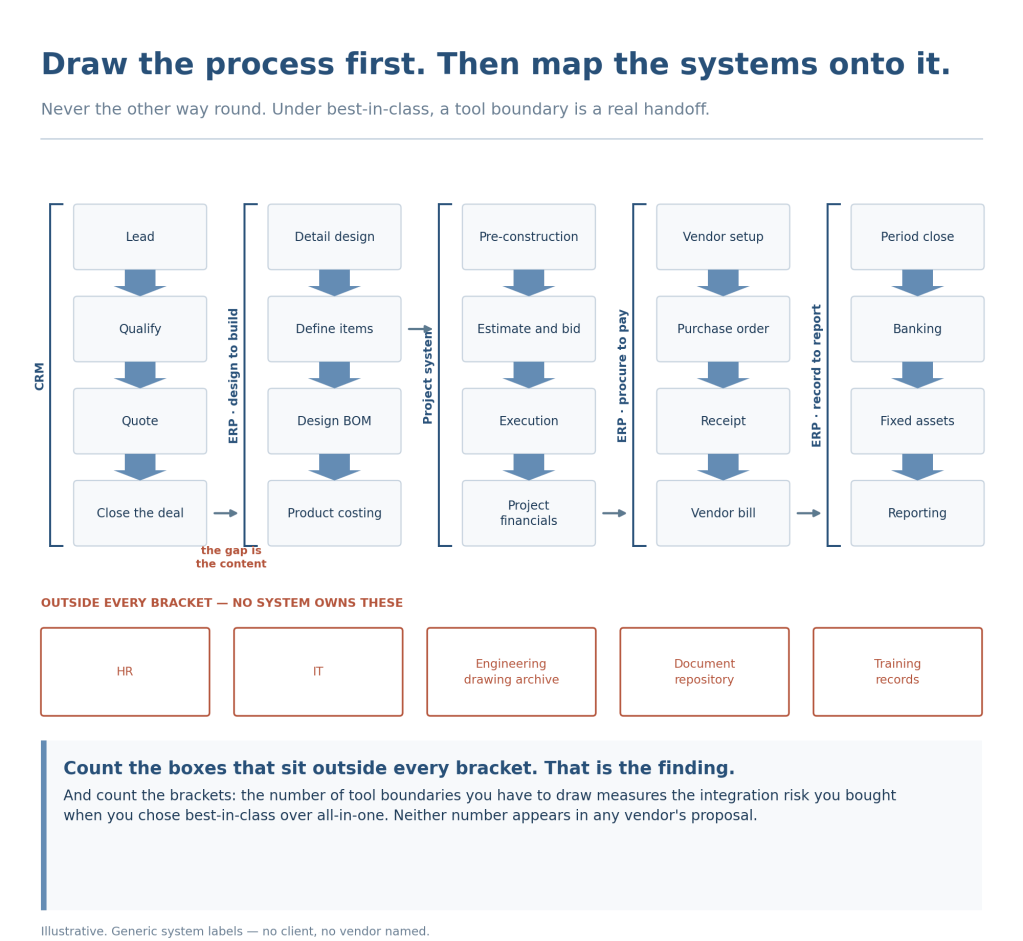
Buy for the company you are, not the tier you are sold. Configure; do not customize — you are not competing on your accounts-payable process. Budget the internal cost, not just the license; the expensive part is your own people’s time. Own the data migration rather than handing it to the implementer. And test the reports you run the business on against vendor demo data before you sign, not after.
I don’t resell the software, implement it, or take a margin on the license. That is the point: the read is about your operational control, not about closing a sale — which is how it reaches the answer a reseller structurally cannot give you. Not yet, or not that one, or fix the definition first and buy nothing this quarter.
A system is a rib. It bears load only where there’s a skeleton to bolt it to.
The same question, four chairs
It is rarely just a buying decision. The same diagnostic runs in four rooms:
- Selecting — the decision above, run before the money is spent
- Scaling — will the system you have carry three times the volume, or is it the ceiling you are about to hit
- Diligence — is the target’s system an asset, or an unpriced liability the deal has not costed
- Contract manufacturing — has your CM got the tools to give you real visibility, or are you flying blind through their spreadsheet
You end up with
An independent read on the system decision, and the discipline to hold it against a process built to rush you.
- Whether you need it, whose problem it solves, and whether the skeleton is there to carry it
- A business process architecture — your processes, their sequence, and the handoffs between them — drawn before the phasing is agreed, and usable as the index to your procedures
- The PDM/PLM/ERP boundary drawn on paper before a vendor is met
- A requirement set and weighted vendor scorecard with three-year cost of ownership
- A data migration and go-live plan owned by operations, not the implementer
- The reports you run the business on, proven from demo data before you sign
When this is the wrong tool
If the part numbers don’t mean one thing yet, the tool is not the answer and this is premature — fix the definition first. The moment the skeleton is real, the system decision is the highest-leverage one on the table, and the easiest to get expensively wrong.
Related: the skeleton this stands on · the diligence chair · the ERP field guide.

