
Planning, visibility & risk
It’s hard to make forecasts, especially about the future
“Sales promised it. Nobody asked operations.”
The forecast will be wrong. The job is one plan everyone works to, and knowing within a week when it has stopped being true. Two deliverables here, and they are not the same job — one produces the plan, the other tells you when it has broken.
Deliverable one
Sales and operations planning
▸ Read the thinking first: the forecast will be wrong, do it anyway
What it looks like from the inside. Sales submit a number nobody believes, operations build to a different one they do not publish, and finance holds a third. Purchase commitments run further forward than confirmed backlog. Nobody can say what you are able to promise a customer next quarter without going away to work it out.
Sales and operations planning designed as a process with roles, a calendar and decision rights — not as a monthly meeting that people attend.
Demand and supply modeled with probability rather than a single number. A forecast with one number in it is a wish; a forecast with a probability attached is a plan. And the supply side gets the same discipline — what is contracted separated from what is merely expected, because a plan that adds them together is optimism with a total at the bottom.
The horizon is set by your longest lead-time item, not by the financial year. If that produces an uncomfortable number, that is the finding.
You end up with
An operating rhythm the business runs to, and one agreed plan instead of three private ones.
- Planning calendar with roles and decision rights
- Demand plan carrying volume, timing and probability
- Supply plan separating contracted capacity from expected
- Monthly view of what you can actually promise, and where the shortages are
Deliverable two
Weekly reports people actually read
▸ Read the thinking first: five principles of weekly reports
What it looks like from the inside. Every status update starts with a question somebody has to answer verbally. A two-hundred-row purchase order dump that contains everything and communicates nothing. “Delayed”, with no cause, no new date and no owner.
Reporting by exception, on a fixed cadence, in a frozen format, pushed rather than parked somewhere for people to find.
If they have to ask, the report has already failed.
You end up with
A weekly report the board reads without asking a single follow-up question.
- Exception report with cause, new date, confidence and owner on every line
- A fixed cadence and a frozen format, so the shape of the report is never the news
- A forward lookahead, not a description of last week
And the risk half
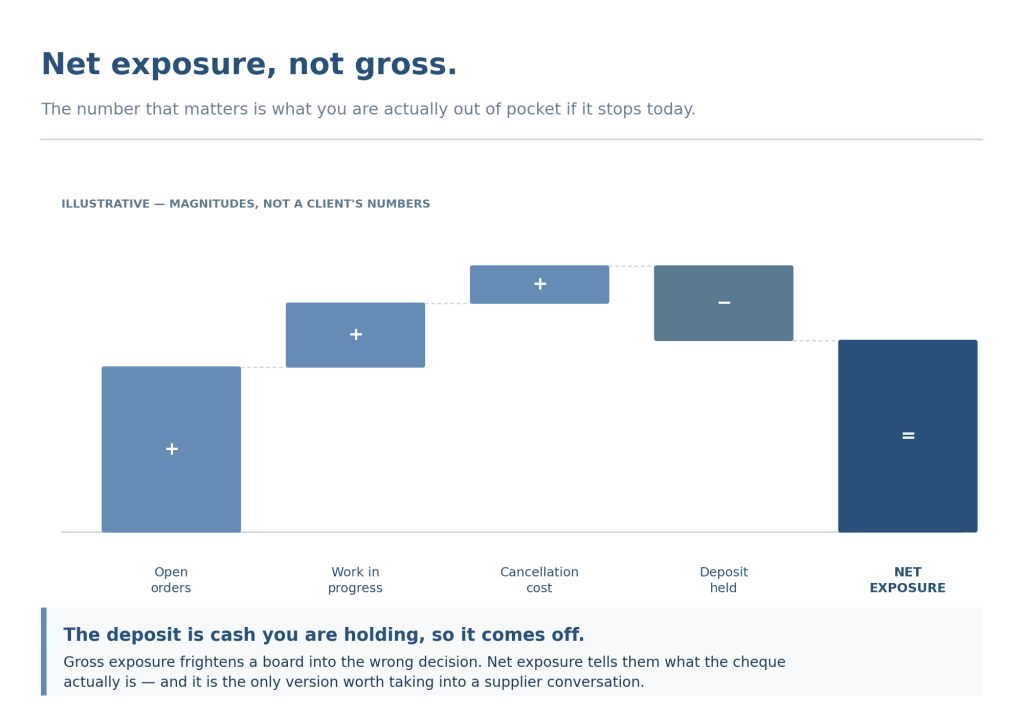
Net exposure, not gross. Work in progress classified by whether it can be redeployed, reviewed weekly, and modeled to the worst case before the worst case arrives — a work-in-progress exposure view showing open orders, work in progress, cancellation cost, deposit offset and net exposure, and a scenario table built before the event rather than during it. When the market has already turned, that becomes its own piece of work: the market just turned. what now? →
And if the ERP is the constraint, selection run from the operations chair — process audit before vendor shortlist, always in that order. Install the people before the tool. A system bought before the person who will own it exists is a very expensive way of making your current process permanent.

