
Product definition & change control
Knowing exactly what you ship
“Nobody knows which revision is current, and changes cost us money we never see.”
▸ Read the thinking first: the engineering skeleton · the PLM field guide · engineering change
The bill of materials is the control artifact. Whoever owns it owns the product.
What it looks like from the inside
- A folder called LATEST_REV_FINAL_v3_USE_THIS_ONE
- Verbal and email change authorizations with no system record
- Procurement ordering to a revision engineering superseded a fortnight ago
- Suppliers told about changes before a notice is issued
- Field as-builts that do not match the released design
The method
Request, then order, then notice — with formality that increases as commitment increases. A change before anything is committed should take an afternoon. The same change after tooling is cut should be hard, and visibly so.
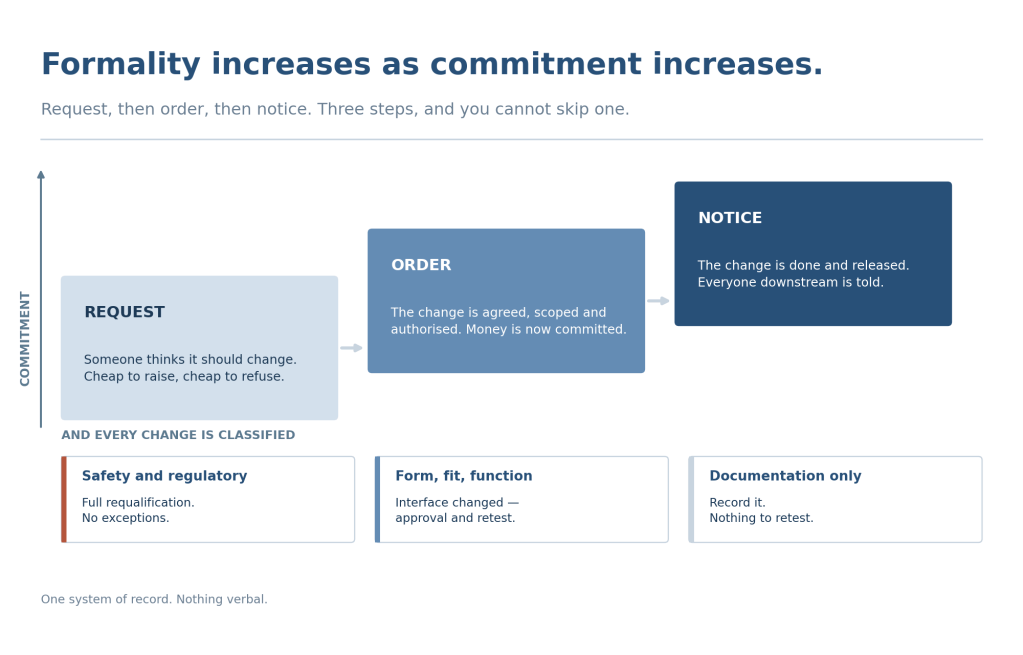
Changes are classified before they are processed: safety and regulatory, form-fit-function, or documentation only. The class sets the timeline and the approvers, which is what stops a documentation correction sitting in the same queue as a safety change.
A change control board with a named chair, real membership, and blocking authority that has been earned rather than assumed — and a different composition before and after purchase commitment.
Bill of materials architecture, part numbering and serialization decided once and then enforced. Intelligent or non-significant numbering is a real decision with real consequences; the failure is not choosing wrong, it is never choosing.
And the system that carries all of this is its own decision, taken next — where the boundaries between product data management, lifecycle management and the ERP get drawn, before any vendor is met. That is buy the system last: the skeleton first, the tool that sits on it second.
Fast but formal. Not all changes are equal. The system of record is the only record.
You end up with
A change process your managers run without me, and a single answer to “what are we shipping today.”
- The process on one page, with every function that decides named against it
- Change board charter covering membership, quorum, escalation and a thirty-day stand-up plan
- Bill of materials policy setting the form-fit-function rule, substitution rights and how far down you trace
- Part numbering standard, decided and defended
- Where a system is needed, a requirement set and a weighted vendor scorecard with three-year cost of ownership
When this is the wrong tool
If you genuinely build one-offs and always will, this is overhead. The moment you build the same thing twice, it is not.

