
Whitepaper · Scale & the cost competition
The price is already falling. Your cost has to fall faster.
You scaled, and you can build more. But the selling price has been falling since the day you shipped, and volume alone will not save the margin — the cost has to fall faster than the price, and you have to plan it that way from the start.
You launched on technology. For a while only you can do it, and the phone rings on its own. That stage feels like the business. It isn’t. It is the shortest part of the business, and the selling price started falling the day you shipped.
Three stages, one direction
Equipment markets move through three stages, and they always move the same way. Stage 1 — only you can do it. Technology sets you apart, you name the price, the margin is fat. Stage 2 — better, faster, cheaper. Rivals climb the same curve; now you win on execution, on yield and lead time and cost, and the margin erodes. Stage 3 — now we compete on price. The product is commoditized. What decides the sale is price, brand, installed base, service, financing — everything except the thing you built. Every equipment category you can name has walked this road. The only variable is how fast.
Stage 1 is always short. The cost position you build in Stages 2 and 3 is what buys your ticket back to the top.
The three stages, in one view
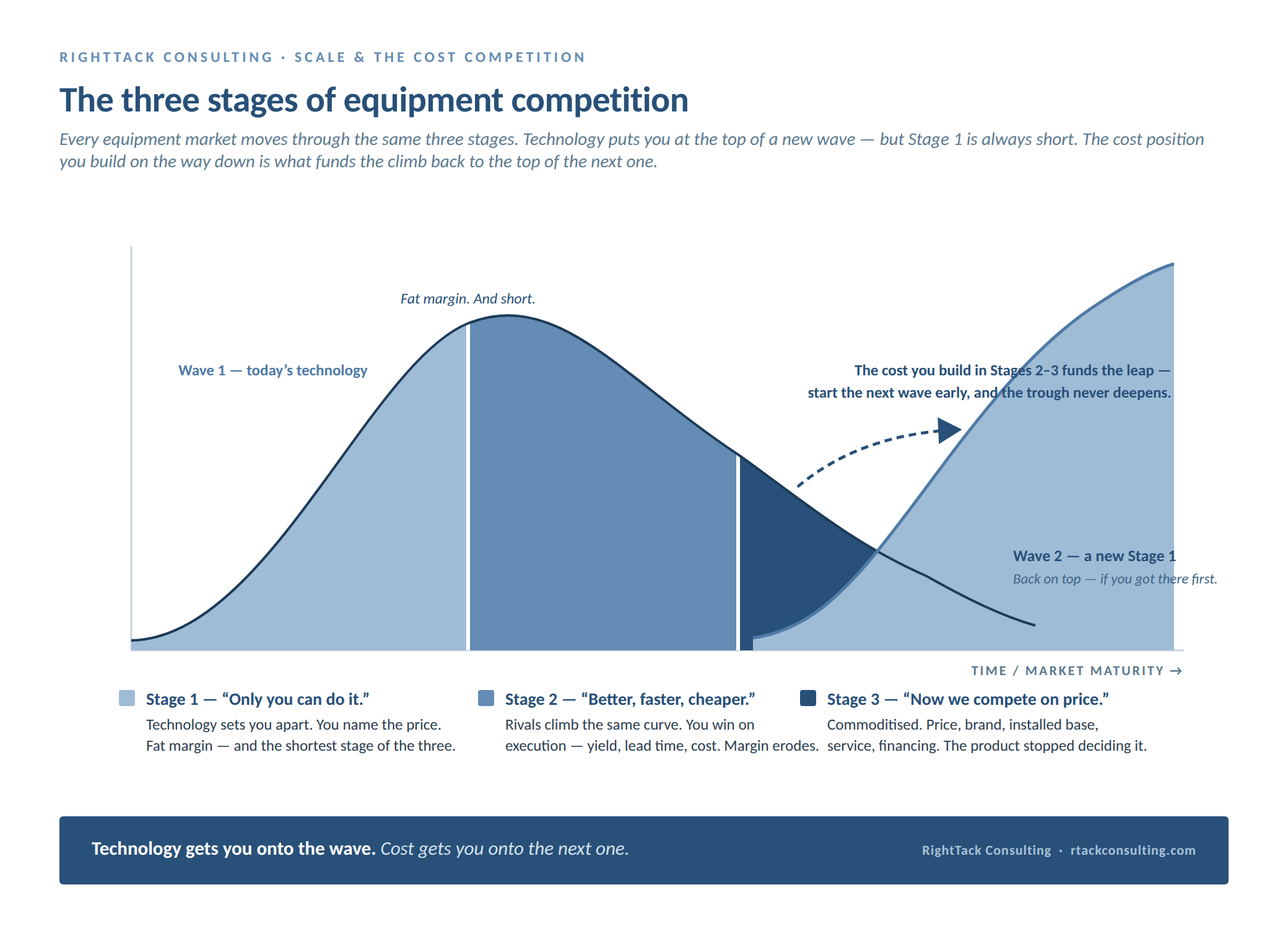
Stage 1 is short. Start the next wave before the old one bottoms out and the waves overlap — the trough never falls to the price-war floor, and the next wave is a new Stage 1.
Here is the part most teams miss. Technology strategy matters — it is what puts you at the top of a new wave. But it buys you Stage 1, and Stage 1 is short. If your whole plan is the next feature, you will spend your best years defending a position that is already eroding, and arrive at the next wave with an empty tank. The cost position you grind out through Stages 2 and 3 is not book-keeping. It is the war chest that funds the R&D and the retooling to reach the next wave’s Stage 1 before anyone else. Miss it, and someone else is at Stage 1 while you are stuck at Stage 3 on the old one.
So cost-down is not a project you start when margins get tight. It is a plan you build on day one, because you are racing a price line that began falling before you had anything to sell.
The failure mode
A team treats cost as a fixed property of the product and price as the thing that moves. They defend the margin by chasing volume and squeezing one supplier once a year, while the price line drops on its own schedule, indifferent to the annual negotiation. The gap opens a little at a time and then all at once — and by the time it shows up in the margin, the cost-out that would have closed it needed twelve to eighteen months of lead time nobody spent. Worse, the cash that would have funded the next wave went into holding the last one. They didn’t lose on technology. They lost because they never built the cost position that pays for the next technology.
Plan the cost curve on day one
The mechanism is the strategic-sourcing cost-out discipline. It is not a negotiation trick. It is a plan for making cost fall faster than price, on a schedule, forever.
Map the spend before you touch a supplier. Pareto the bill of materials by category. A handful of categories carry most of the cost. You work those, not all of them, and you know your number: the addressable spend, and what fraction of unit cost each category is.
Classify every category three ways. This is the whole discipline. It is the same schedule-versus-wall logic that runs the readiness assessment, pointed at cost instead of capacity.
Every category is one of three things
- Addressable — you can move it now, through competition, redesign, consolidation or geography.
- Constrained — real savings sit behind a gate: a qualification, a single source, a customer spec, a tooling commitment. A schedule — price the lead time and start it now because it is slow. Assuming you can squeeze it next quarter is mistaking a wall for a schedule.
- Not addressable — sole-source IP, customer-directed, regulatory. Name it, stop spending negotiation energy on it, move on.
Quantify the opportunity with should-cost, not last year minus a few points. Put a low and a high number on each addressable category — a percent and a per-unit figure. Build them two ways. Top-down should-cost is fast and parametric: it sizes the prize across a category from weight, process and complexity against benchmarks, and it lets you set an aggressive but defensible target and rank the work before you engage a soul. Bottom-up should-cost is the number you negotiate to: material mass times material price, plus process time times shop rate, plus tooling, yield loss, overhead and margin — the cost built from first principles, line by line. Underneath both sits a shop-rate build-up by region and a landed-cost model, so that an Asia or low-cost-country move is judged on true delivered cost, not the headline unit price. That last point is where half the off-shoring cases quietly die.
Rank by prize against ease, and cut it into waves. Savings potential on one axis, ease of deployment on the other. High-value and low-effort is Wave 1. High-value and hard is Wave 2 — and you start its long-lead qualifications during Wave 1, not after. Low-value and hard you may never do; say so out loud, rather than leaving it on a list pretending to be planned.
Pull the levers in order of speed. Competition and re-sourcing move fastest where a real second source exists. Then consolidation — fewer suppliers, more volume each, a better price. Then should-cost-led negotiation against the number you built. Then geography and low-cost-country, which is real money behind a qualification gate, so a schedule. Then design-to-cost, the deepest lever and the slowest — and the point where I bring in the DFM and specific-technology specialists; I own the target and the integration, they own the teardown. And underneath all of it, the terms, the VMI, the logistics — cash and landed cost, not unit price, but they count.
Phase it honestly — and show leadership the trough. Plot three curves over time: cumulative savings, cumulative implementation expense, and the net. The honest shape is that you spend before you save; the net goes underwater before it turns. If leadership doesn’t see the trough coming, the program dies the first quarter it costs money instead of making it. Show the aggressive case and the conservative one side by side, and let them choose the pace with their eyes open.
You spend before you save
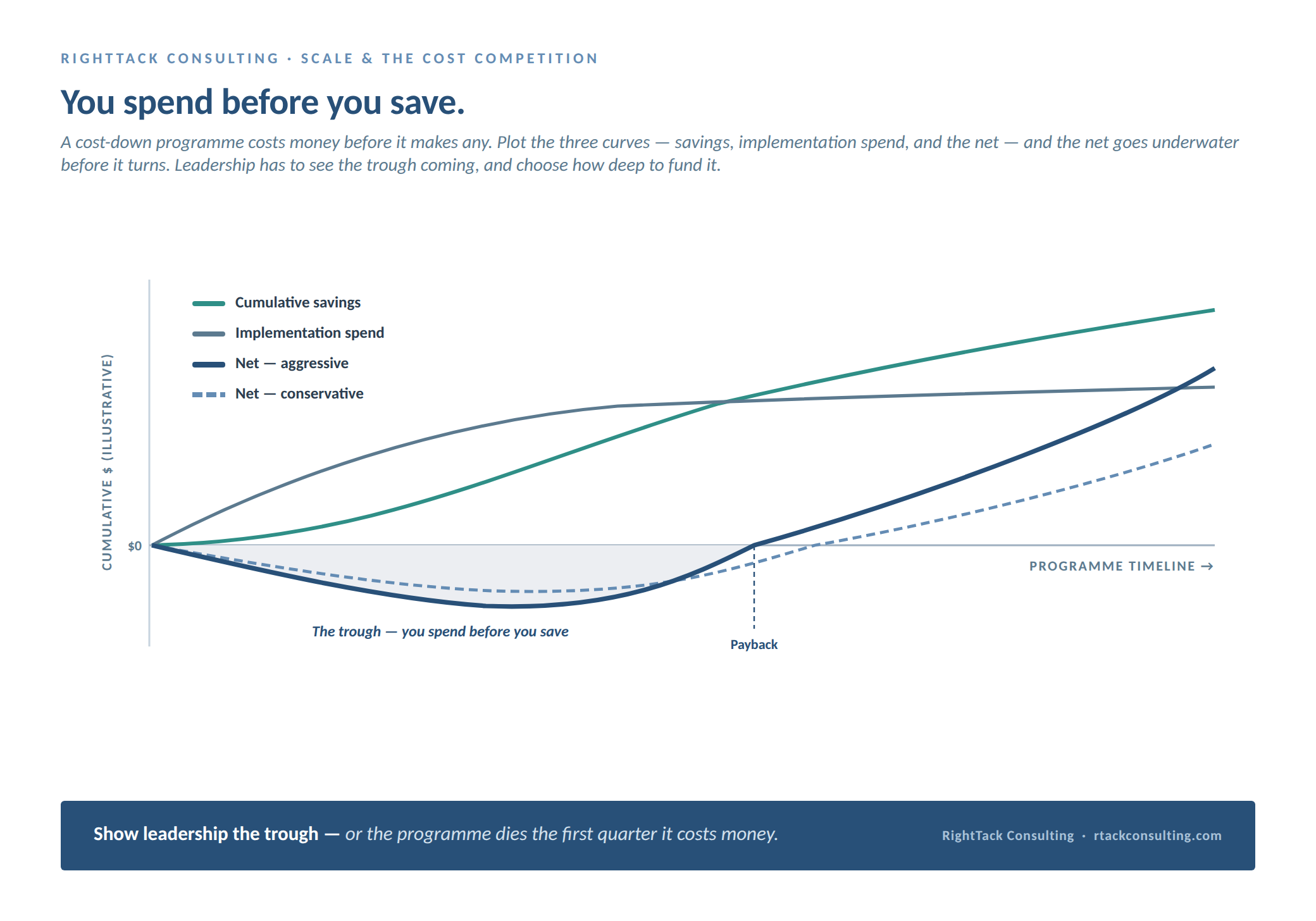
The net goes underwater before payback. Aggressive digs a deeper trough and recovers faster and higher; conservative is shallower and slower. Leadership funds the trough with its eyes open, or the program dies the first quarter it costs money.
Run it against the price line, on a cadence. Cost-down is not a project that closes. Re-baseline against where the selling price actually went, not where you forecast it. If price fell faster than cost this period, you are behind, and the plan changes.
Shorten the trough
There is one more move, and it is the whole reason to plan early. If you wait until the old wave has bottomed out to start the next one, you take the full fall — you sit at the price-war floor while you rebuild. But if you have the cost position and the cash to launch the next wave before the old one bottoms, the two waves overlap. The new Stage 1 rises while the old Stage 3 is still declining, the curves cross, and the margin never falls all the way to the floor. The next wave is a new Stage 1 — you are back at the top — and you got there first because the cost war chest paid for the leap. That is the difference between a cost plan and a hope.
Technology gets you onto the wave. Cost gets you onto the next one.
Where this sits
This is not the sourcing method, though it uses it. Four-tier sourcing is how you buy; this is how you plan the cost to keep falling — driven by the price curve, not the category calendar, with the sourcing engine as one of its levers. And it is the second half of scaling: ramp readiness gets you building more; this keeps the margin alive once you can.
A word on where I sit in this
I own the cost-down bar — the classification, the ranking, the phasing, and the discipline of racing the price line. The deep design-to-cost teardown and the specific-technology should-cost, I bring in specialists for and integrate. What I bring is the plan, and the judgment about what is a schedule and what is a wall.
Most teams can build more. Fewer plan to build it cheaper, faster than the price is falling.
That is the work I do.
Where this goes next
The volume arrived. The margin did not. →
The cost-down method — spend map, should-cost models built bottom-up, cost-out in waves, and a phasing chart that names the month the net turns positive. It sits on the same pillar as ramp readiness: get the line steady, then take the cost out.

